Have you ever caught yourself spiraling into negative thoughts, only to realize hours later that you’ve been stuck in the same mental loop? Or maybe you’ve avoided that important phone call for weeks, knowing full well it’s making your anxiety worse?
You’re not alone. Our behaviors, both helpful and harmful, are patterns we’ve learned over time. The good news? What’s learned can be unlearned.
Behavioral therapy offers proven methods of behavior change that can help you break free from destructive patterns and build healthier habits. Let’s explore the most effective behavioral therapy techniques that therapists use to help people transform their lives.
What Is Behavioral Therapy?
Behavioral therapy is a type of psychotherapy that focuses on changing problematic behaviors by addressing the thoughts and patterns that drive them. Unlike traditional talk therapy that explores your past, behavioral therapy is action-oriented and focused on the present.
The core principle behind every behavioral therapy technique is simple: our thoughts, feelings, and behaviors are interconnected. When you change one, the others shift too.
Three Types of Behavioral Therapy
Before diving into specific techniques, it’s helpful to understand the main approaches to behavioral therapy:
Cognitive Behavioral Therapy (CBT)
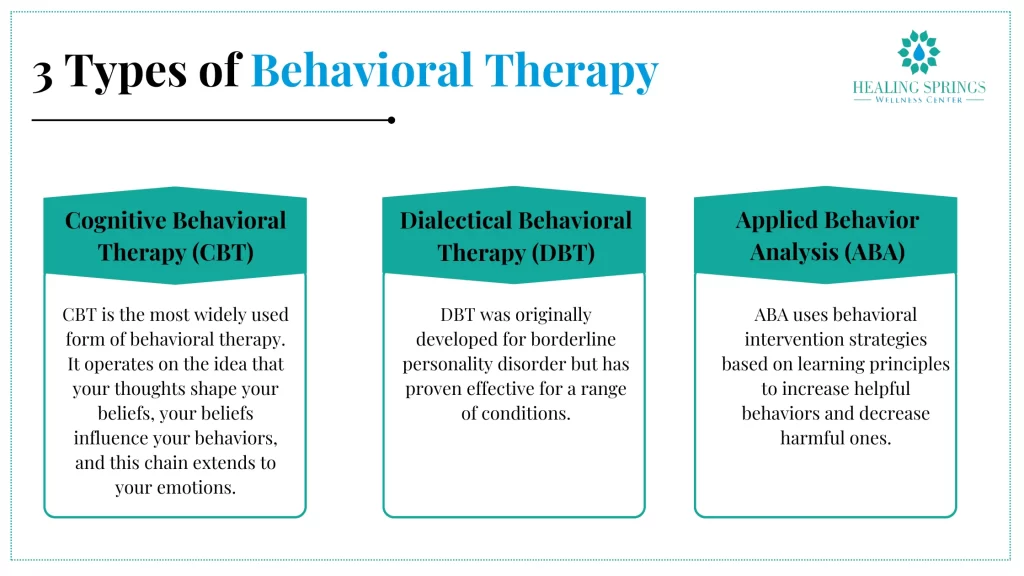
CBT is the most widely used form of behavioral therapy. It operates on the idea that your thoughts shape your beliefs, your beliefs influence your behaviors, and this chain extends to your emotions.
A behavior therapist using CBT helps you identify negative thought patterns, challenge their validity, and replace them with more balanced, realistic thoughts. This method of behavior change is highly structured and typically time-limited, making it ideal for people seeking focused solutions to specific problems.
Dialectical Behavioral Therapy (DBT)
DBT was originally developed for borderline personality disorder but has proven effective for a range of conditions. This technique of behavioral therapy balances two seemingly opposite ideas: accepting yourself as you are while simultaneously working to change.
DBT focuses on four core skills: mindfulness, distress tolerance, emotion regulation, and interpersonal effectiveness. Unlike CBT’s emphasis on changing thoughts, DBT emphasizes managing emotions and accepting discomfort as part of the human experience.
Applied Behavior Analysis (ABA)
ABA uses behavioral intervention strategies based on learning principles to increase helpful behaviors and decrease harmful ones. This method of behavior is commonly used in treating autism spectrum disorders and developmental disabilities, particularly as child behavioral therapy techniques.
The 3 C’s of Behavior Therapy
One of the most practical methods of behavior modification in CBT is the “3 C’s” technique: Catch, Check, and Change.
Catch: The first step is becoming aware of negative or unhelpful thoughts as they occur. Many people go through their day on autopilot, unaware of the constant stream of negative self-talk running through their minds.
Check: Once you’ve caught a negative thought, question it. Is this thought based on facts or feelings? What evidence supports or contradicts it? How would you respond if a friend had this thought?
Challenge: After checking the validity of your thought, replace it with a more balanced, realistic alternative. This isn’t about forcing positive thinking, it’s about finding truth.
This behavioral management therapy technique empowers you to take control of your thought patterns rather than letting them control you.
Exposure Therapy and Systematic Desensitization
Fear and avoidance often go hand in hand. The more you avoid something you fear, the more power that fear gains over your life. Exposure therapy directly challenges this cycle.
How Exposure Therapy Works
In exposure therapy, you gradually face the things you fear in a safe, controlled environment. This might involve:
- Imaginal exposure: Vividly imagining the feared situation
- In vivo exposure: Directly confronting the fear in real life
- Virtual reality exposure: Using technology to simulate feared scenarios
The goal isn’t to eliminate fear entirely, it’s to learn that you can tolerate discomfort and that your feared outcomes rarely come true.
Systematic Desensitization
Systematic desensitization is a gentler form of exposure that combines relaxation techniques with gradual exposure. Here’s how this behavioral therapy technique works:
First, you learn deep relaxation methods like progressive muscle relaxation or controlled breathing. Then, with your behavior therapist, you create a “fear hierarchy”, a ranked list of situations from least to most anxiety-provoking.
Starting with the least threatening scenario, you practice relaxation while gradually confronting each level of your fear. Because you can’t be relaxed and anxious at the same time, this method of behavior change helps you replace fear responses with calm ones.
This technique is particularly effective for treating specific phobias, social anxiety, and PTSD.
The 5-Minute Rule
Procrastination might seem like a time management problem, but it’s actually an emotional regulation issue. We avoid tasks that trigger uncomfortable feelings, boredom, anxiety, overwhelm, or fear of failure.
The 5-Minute Rule is a brilliantly simple behavioral intervention strategy for procrastination. Here’s how it works:
Commit to working on a dreaded task for just five minutes. Set a timer. When it goes off, you’re free to stop, no guilt, no pressure.
The psychological magic happens because starting is often the hardest part. Once you overcome that initial resistance and build momentum, you’ll frequently find yourself wanting to continue past the five minutes.
This technique works because it:
- Reduces overwhelm by making tasks feel manageable
- Leverages momentum to keep you going
- Builds the discipline of starting
- Minimizes perfectionism by removing pressure
Whether you’re avoiding exercise, studying, or household chores, the 5-Minute Rule makes behavior change feel achievable.
Behavioral Activation
When you’re depressed or anxious, you naturally withdraw from activities. You stop seeing friends, skip the gym, and spend weekends in bed. Unfortunately, this withdrawal actually worsens your mood, creating a vicious cycle.
Behavioral activation reverses this pattern. This behavioral therapy technique involves scheduling and engaging in activities that bring accomplishment or pleasure, even when you don’t feel like it.
The principle is simple: behavior change precedes mood change. When you act first, even without motivation, your feelings eventually follow.
A behavior therapist using this method might help you:
- Identify meaningful activities you’ve abandoned
- Schedule specific times for these activities
- Track your mood before and after engaging in them
- Gradually increase your activity level
Positive Reinforcement and Reward Systems
Methods of behavior change aren’t just about stopping negative patterns, they’re also about building positive ones. Positive reinforcement involves rewarding yourself for desired behaviors, making them more likely to continue.
This behavioral management therapy approach is particularly effective for:
- Building new habits
- Child behavioral therapy techniques
- Addiction recovery
- Lifestyle changes
The key is choosing rewards that are meaningful but not counterproductive. Finished a week of healthy eating? Treat yourself to a massage, not a binge. Completed a difficult work project? Take a relaxing bath, not a drinking session.
Mindfulness-Based Techniques
While mindfulness has roots in ancient meditation practices, modern behavioral therapy techniques incorporate it as a powerful tool for behavior change.
Mindfulness teaches you to observe your thoughts and feelings without judgment or reaction. Instead of being swept away by anxious thoughts or uncomfortable emotions, you learn to notice them, acknowledge them, and let them pass.
This creates space between stimulus and response, a gap where you can choose how to react rather than acting on autopilot.
Mindfulness is a core component of DBT and is increasingly integrated into various methods of behavior therapy.
Child Behavioral Therapy Techniques
Children require different behavioral intervention strategies than adults. Effective child behavioral therapy techniques include:
- Play therapy: Using play to help children express and work through emotions
- Parent-child interaction therapy: Teaching parents to use specific behavioral management therapy approaches
- Token economy systems: Rewarding positive behaviors with tokens exchangeable for privileges
- Social skills training: Teaching appropriate interaction methods through role-play and practice
The most effective technique of behavioral therapy for children involves the entire family system, ensuring consistency between therapy sessions and home life.
FAQ: Understanding Behavioral Therapy
What are the three types of behavioral therapy?
The three main types are Cognitive Behavioral Therapy (CBT), which focuses on changing thought patterns; Dialectical Behavioral Therapy (DBT), which balances acceptance and change; and Applied Behavior Analysis (ABA), which uses reinforcement principles to modify behavior.
Is CBT or DBT better for me?
CBT is typically better for anxiety, depression, and phobias where changing thought patterns is the primary goal. DBT is often more effective for emotional regulation issues, borderline personality disorder, self-harm behaviors, and situations requiring acceptance alongside change. A qualified behavior therapist can help determine which approach fits your needs.
What are the 3 C’s of behavior therapy?
The 3 C’s are Catch (identify negative thoughts), Check (question their validity), and Change (replace them with balanced alternatives). This simple framework makes cognitive restructuring accessible and practical for daily use.
What are CBT techniques examples?
Common CBT techniques include the 3 C’s, exposure therapy, behavioral activation, thought records, the 5-Minute Rule, cognitive restructuring, and systematic desensitization. Each technique targets different aspects of the thought-feeling-behavior cycle.
What is the 5-minute rule in CBT?
The 5-Minute Rule is a behavioral intervention strategy for procrastination. You commit to working on an avoided task for just five minutes, after which you can stop guilt-free. This reduces overwhelm and creates momentum, making it easier to continue beyond the initial five minutes.
What’s the difference between CBT and behavioral therapy?
CBT is actually a type of behavioral therapy. Traditional behavioral therapy focuses primarily on changing behaviors through methods like reinforcement and conditioning. CBT expands this by also addressing the thoughts and beliefs that drive behaviors, making it a more comprehensive approach.
Why is CBT falling out of favor?
CBT isn’t falling out of favor, it remains one of the most researched and effective therapies. However, some practitioners now recognize that CBT alone isn’t sufficient for everyone. This has led to the development of “third-wave” therapies like DBT and Acceptance and Commitment Therapy (ACT), which incorporate mindfulness and acceptance alongside behavior change.
Is DBT or CBT better for anxiety?
CBT is typically the first-line treatment for most anxiety disorders because it directly addresses anxious thoughts and avoidance behaviors. However, DBT can be more effective if your anxiety involves intense emotional reactions, self-harm, or difficulty tolerating distress. Many people benefit from a combination of both approaches.
Take Control of Your Behaviors Today
Behavioral therapy techniques offer more than just theoretical concepts, they provide practical, actionable methods of behavior change you can start using immediately. Whether you’re struggling with anxiety, depression, procrastination, or unhealthy habits, these evidence-based strategies can help you break free from negative patterns.
The journey from recognizing a problem to changing it isn’t always easy, but with the right behavioral intervention strategies, it’s absolutely possible. Ready to transform your behavioral patterns with professional guidance? Our experienced therapists at Healing Springs Wellness specialize in evidence-based behavioral therapy techniques tailored to your unique needs. Schedule your consultation today and discover which methods of behavior change will work best for you.
This article is for informational purposes only. If you’re experiencing mental health concerns, please consult with a qualified behavior therapist or mental health professional.