
It’s 3 AM, and your mind is racing. You’re replaying that conversation from work for the hundredth time. What did they really mean? Did you say the wrong thing?
If your brain feels like a browser with 47 tabs open, you’re not alone. Overthinking affects millions of people, turning simple decisions into exhausting mental marathons and peaceful moments into anxiety-filled spirals.
As we step into the new year, you have the perfect opportunity to break free from the overthinking cycle and reclaim your mental peace.
Understanding Overthinking
Overthinking is the habit of dwelling on thoughts, decisions, or situations far beyond what’s helpful. It’s when your mind gets stuck in a loop, analyzing and re-analyzing until you’re mentally exhausted.
Unlike productive problem-solving, overthinking keeps you trapped without reaching resolution. You might replay past conversations endlessly, imagine worst-case scenarios, or spend hours agonizing over minor decisions.
As one popular overthinking quote reminds us: “Overthinking is the art of creating problems that weren’t even there.
Read our guide on anxiety hacks to stop overthinking and regain control.
What Is Overthinking a Symptom Of?
Overthinking isn’t a disorder itself, but it’s commonly associated with several mental health conditions:
Anxiety Disorders – Over thinking anxiety is one of the most common manifestations. People with generalized anxiety disorder frequently experience excessive worry and rumination about everyday situations.
Depression – When depressed, overthinking often takes the form of rumination repeatedly dwelling on negative thoughts and past mistakes.
OCD – Obsessive-compulsive disorder involves intrusive thoughts that lead to compulsive overthinking patterns.
PTSD – Trauma survivors often overthink as they try to make sense of their experiences or prevent future harm.
Perfectionism – The need for everything to be perfect drives excessive analysis of decisions and actions.
Why Do I Overthink Everything?
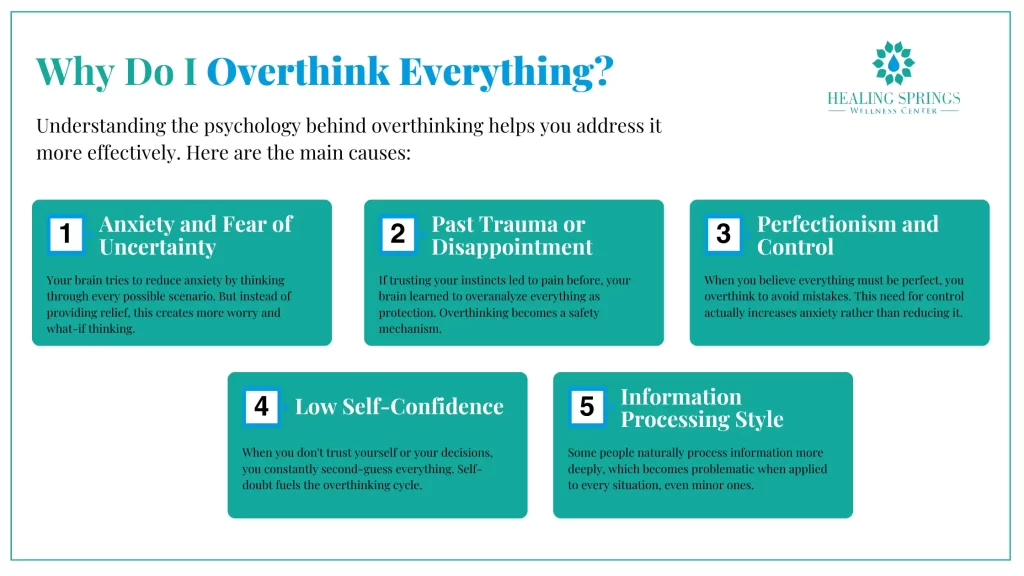
Understanding the psychology behind overthinking helps you address it effectively.
Your Brain’s Protection Mechanism
Your brain evolved to identify threats and solve problems. Sometimes, this protective mechanism goes into overdrive, treating minor issues as major threats requiring extensive analysis.
Learned Patterns from Childhood
If you grew up in unpredictable environments or faced criticism for mistakes, your brain learned to anticipate problems by overthinking every possibility.
Fear of Uncertainty
Humans crave certainty. Overthinking creates the illusion of control, if you think about every possible outcome, maybe you can prevent bad things from happening.
Unresolved Emotional Issues
Sometimes overthinking is your mind’s way of avoiding uncomfortable emotions. It’s easier to analyze a situation intellectually than to feel the associated feelings.
Common Overthinking Symptoms
Recognizing overthinking symptoms helps you catch the pattern early:
Mental Symptoms:
- Constant worry about past or future events
- Difficulty making decisions, even minor ones
- Second-guessing yourself repeatedly
- Creating worst-case scenarios in your mind
- Mental exhaustion from continuous thinking
Physical Symptoms:
- Difficulty sleeping or racing thoughts at night
- Headaches and muscle tension
- Fatigue despite lack of physical activity
- Difficulty concentrating on tasks
- Restlessness and inability to relax
Emotional and Behavioral Signs:
- Increased anxiety and stress levels
- Procrastination due to analysis paralysis
- Avoiding social situations or new experiences
- Seeking constant reassurance from others
- Difficulty being present in the moment
You may also find our reduce your anxiety guide helpful for daily coping.
What Happens If You Overthink Too Much?
Chronic overthinking takes a significant toll on your life:
Mental Health Decline – Persistent overthinking increases risk of anxiety disorders and depression. The constant mental strain depletes your emotional resources.
Physical Health Problems – Stress from overthinking can lead to sleep disorders, weakened immune system, digestive issues, and cardiovascular problems.
Damaged Relationships – Overanalyzing conversations and reading into every interaction can create unnecessary conflict and distance in relationships.
Missed Opportunities – Analysis paralysis prevents you from taking action, causing you to miss out on experiences, relationships, and opportunities.
Decreased Productivity – Spending hours overthinking decisions leaves less time and energy for actual work and meaningful activities.
How Do You Break the Cycle of Overthinking?
Here are therapist-recommended strategies to stop overthinking:
1. Practice the 3-3-3 Rule for Overthinking
When you notice yourself spiraling, use this grounding technique: Name 3 things you see, 3 sounds you hear, and move 3 parts of your body. This simple practice interrupts the overthinking loop and brings you back to the present moment.
2. Set a “Worry Time”
Designate 15-20 minutes daily for overthinking. When worries arise outside this time, write them down and save them for your worry period. This contains the overthinking and prevents it from consuming your entire day.
3. Challenge Your Thoughts
Ask yourself: Is this thought helpful? Is it based on facts or assumptions? What would I tell a friend having this thought? This cognitive restructuring helps you separate productive thinking from destructive overthinking.
4. Practice Mindfulness Meditation
Regular mindfulness practice trains your brain to observe thoughts without getting caught in them. Even 5-10 minutes daily can significantly reduce overthinking patterns.
5. Take Action, Even Small Steps
Overthinking thrives on inaction. Make a decision and commit to it, even if it’s not perfect. Taking action breaks the cycle and builds confidence in your judgment.
6. Limit Information Intake
Constantly scrolling social media or news feeds fuels overthinking. Set boundaries on information consumption to give your mind space to rest.
7. Use Physical Movement
Exercise and physical activity interrupt overthinking by shifting your focus to your body. A walk, yoga session, or workout can reset your mental state.
8. Practice Self-Compassion
Stop beating yourself up for overthinking. Treat yourself with the kindness you’d show a friend. Self-criticism only adds another layer to the overthinking cycle.
How Do You Treat Overthinking?
Professional treatment options can provide significant relief:
Cognitive Behavioral Therapy (CBT)
CBT is highly effective for treating overthinking disorder patterns. It helps you identify distorted thinking patterns and replace them with more balanced perspectives.
Acceptance and Commitment Therapy (ACT)
ACT teaches you to accept thoughts without fighting them, reducing the power overthinking has over you.
Mindfulness-Based Stress Reduction (MBSR)
This structured program combines mindfulness meditation with stress reduction techniques specifically designed to break overthinking cycles.
Medication
For overthinking linked to anxiety or depression, medication may help manage underlying symptoms, making it easier to implement behavioral strategies.
Explore the best therapies for every type of anxiety to understand what works best.
Do Overthinkers Have a High IQ?
There’s a common misconception that overthinking correlates with high intelligence. While research shows some connection between analytical thinking and intelligence, chronic overthinking isn’t a sign of superior intellect.
Intelligent people can be overthinkers, but so can people of average intelligence. Overthinking is more closely related to anxiety, perfectionism, and learned patterns than to IQ.
In fact, overthinking can actually impair cognitive function by creating mental clutter that interferes with clear thinking and decision-making.
Your New Year Resolution: Peace of Mind
As you enter the new year, remember: you don’t have to live with a constantly racing mind. Breaking the cycle of overthinking is possible with patience, practice, and the right support.
Start small. Choose one strategy from this article and commit to practicing it for the next two weeks. Notice how it feels to give your mind permission to rest.
Your brain is incredibly capable, but it also needs breaks. You deserve mental peace, clarity, and the freedom to be fully present in your life.
The new year isn’t just about resolutions, it’s about releasing patterns that no longer serve you. Let this be the year you stop overthinking and start truly living.
Ready to break free from the overthinking cycle? Our experienced therapists at Healing Springs Wellness specialize in helping people overcome anxiety, overthinking, and mental exhaustion. We offer evidence-based treatments including CBT and mindfulness therapy tailored to your needs. Schedule your consultation today and start your journey toward mental clarity and peace.
FAQ: Your Overthinking Questions Answered
What is overthinking a symptom of?
Overthinking is commonly associated with anxiety disorders, depression, OCD, PTSD, and perfectionism. It’s a symptom rather than a disorder itself, often indicating underlying mental health concerns that need attention.
Why do I overthink everything?
You might overthink due to your brain’s protection mechanism going into overdrive, learned patterns from childhood, fear of uncertainty, or unresolved emotional issues. Understanding your specific triggers helps address the root cause.
What happens if you overthink too much?
Chronic overthinking leads to mental health decline, physical health problems, damaged relationships, missed opportunities, and decreased productivity. It creates stress that affects your entire wellbeing.
How do you treat overthinking?
Treatment includes Cognitive Behavioral Therapy (CBT), Acceptance and Commitment Therapy (ACT), Mindfulness-Based Stress Reduction (MBSR), and sometimes medication for underlying anxiety or depression.
What is the psychology behind overthinking?
Psychologically, overthinking stems from your brain’s evolved threat-detection system, learned behaviors from past experiences, need for control and certainty, and avoidance of uncomfortable emotions.
What is the 3-3-3 rule for overthinking?
The 3-3-3 rule is a grounding technique: Name 3 things you see, 3 sounds you hear, and move 3 parts of your body. This interrupts overthinking and brings you back to the present moment.
Disclaimer: This article is for informational purposes only and does not constitute medical advice. If you’re experiencing severe anxiety or mental health concerns, please consult with our qualified mental health professional.