
Taking care of your mind is equally important as taking care of your body. But in the middle of busy routines, stress and day-to-day responsibilities, mental health often becomes our least priority. The good news is, caring for your mental well-being isn’t always complicated or time-consuming. Simple, mindful mental health exercises can make a real difference.
At Healing Springs Wellness Center, we believe in treating the whole person mind, body, and spirit. Whether you’re navigating anxiety, stress, or simply looking for ways to feel more grounded, incorporating well-being exercises into your daily routine, can help.
Why do mental health exercises matter?
Just as your body needs movement, our mind needs care and support.
With practicing mental health exercises consistently, you may notice:
- Reduced anxiety and overthinking
- Better focus and clarity
- Control over emotions
- A better sense of self-awareness
Over time, these small wellness exercises help you build a life with clarity and intention.
Simple Mental health exercises you can start today
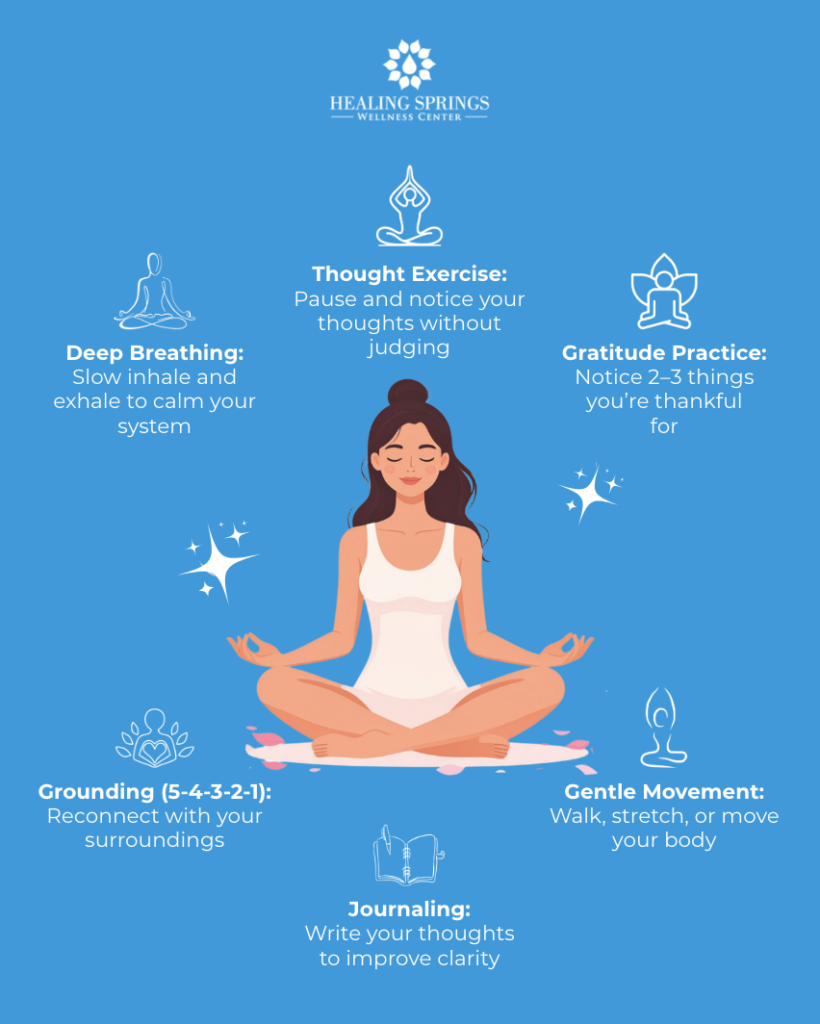
1. Thought exercise: Pause and notice – A simple thought exercise can help you validate your internal thoughts. Pause for a moment and ask yourself “what am I thinking right now?”. This is one of the most effective exercises for happiness that can help you feel more grounded and emotionally aware.
2. Deep breathing practice: This is one of the simplest well-being exercises to relax your mind. Try:
Inhale gently through your nose
- Exhale slowly through your mouth
- Repeat multiple times
3. Grounding exercise (5-4-3-2-1 method): This is a widely used mental health exercise for stress. Notice:
- 5 things you can see
- 4 things you can feel
- 3 things you can hear
- 2 things you can smell
- 1 thing you can taste
This exercise helps reconnect your brain back to the present moment.
4. Journaling for clarity: Writing your thoughts helps in better clarity and focus. Try:
- Writing what you’re feeling at the moment
- Noticing what triggered it
- Reflecting on what you need
This exercise boosts mental fitness.
How to build mental fitness over time
To build mental fitness, one needs to keep in mind that
“Consistency matters more than intensity”
You can:
- Start with one simple thought exercise each day
- Avoid putting pressure on yourself to do everything perfectly
Gradually, these small habits can support your mental well-being.
When to seek additional support
Mental health exercises are a great way to relax your nervous system. However, sometimes there are moments when you may need professional support; and that is completely normal. You can consider reaching out to us, if you:
- Feel constantly overwhelmed
- Struggle with persistent stress and anxiety
- Are flooded with emotions
You Deserve Support on Your Healing Journey
Incorporating mental health exercises into your daily life is a gentle act of self-care.
At Healing Springs Wellness Center, we offer a compassionate, holistic approach to mental wellness. Whether you’re seeking exercises for happiness or dealing with anxiety, depression, trauma, or simply the weight of everyday life, our team is here to support you with care, compassion and understanding; at your own pace..
You deserve a space where you are fully seen, heard, and affirmed while working through your emotions.
Ready to take the next step? Schedule a consultation with our team today and begin your journey toward lasting well-being.
Mental Health Exercises Related Frequently Asked Questions
Q: How does exercise improve mental health?
Exercise triggers the release of endorphins and lowers cortisol. It also improves sleep, supports your mental health, and increases blood flow to the brain.
Q: Why is exercise good for mental health?
Because it helps regulate your nervous system as the mind and body are deeply connected. When you move your body, you signal safety to your nervous system.
Q: How does exercise help mental health on a daily basis?
Even small amounts of physical movement including a few minutes walk, meditation session, or stretching can help improve your mental state. Consistency matters more than intensity.
Q: What are the best exercises for mental health?
The best mental health exercises are the ones that are easy and simple to do. Including :
- walking,
- yoga,
- swimming,
- strength training,
These help in improving mood, reducing anxiety, and supporting overall mental fitness.
Q: What is the 3-3-3 rule in mental health?
The 3-3-3 rule is a grounding technique for anxiety. It involves naming :
- 3 things you can see,
- 3 sounds you can hear, and
- Move 3 parts of your body.
It helps bring your focus back to the present moment.
Q: What are the 5 types of coping strategies for mental health?
The five types are:
- Problem-focused coping,
- Emotion-focused coping,
- Social coping,
- Meaning-focused coping, and
- Avoidant coping.
In order to maintain healthy mental fitness, you should develop a balance between the first four skills listed above and avoid the fifth one.
Q: What’s the best exercise for type 2 diabetes?
Brisk walking, cycling, swimming, and resistance training are the most recommended wellness exercises for type 2 diabetes as they are easy to follow daily. These help manage blood sugar, improve insulin sensitivity, and support emotional well-being. Always consult your healthcare provider before starting a new routine.
Q: What are the 7 C’s of mental health?
The 7 C’s are:
- Competence,
- Confidence,
- Connection,
- Character,
- Contribution,
- Coping, and
- Control.
Together, they form a structured framework that supports strong, stable mental health across all age group.
Q: What are 10 coping skills?
Ten practical coping skills include:
- Deep breathing,
- Mindfulness meditation,
- Journaling,
- Physical movement,
- Talking to a therapist,
- Setting boundaries,
- Limiting social media,
- Creative expression,
- Spending time in nature, and
- Practicing self-compassion.
Q: What are 5 warning signs of anxiety?
Watch for:
- Persistent worry,
- Physical tension (headaches, racing heart),
- Sleep disturbances,
- Avoidance behaviors, and
- Difficulty concentrating.
If these feel familiar, reaching out for professional support is recommended.
Q: Does working out help mental health?
Yes. Working out helps mental health by reducing symptoms of depression and anxiety. It is one of the most effective ways to support both mental and emotioal well-being.