
You have been told it is anxiety. You have tried the medication. You have done the breathing exercises. You have tracked your thoughts in a journal.
And still…something does not add up.
You are still forgetting things. Still struggling to start tasks that seem simple. Still feeling like your brain is tuned to a different frequency than everyone around you. Still exhausted in a way that has nothing to do with how much sleep you got.
According to a 2025 review published in Frontiers in Psychiatry, ADHD is a lifetime co-diagnosis of one or more psychiatric disorders in 70 to 80 percent of cases. And anxiety is one of the most common conditions it gets confused with; and confused for. Getting this wrong does not just delay relief. It means years of treating the wrong thing while the real issue goes untreated.
This guide is here to help you understand the real difference between ADHD and anxiety, how they overlap, what it looks like to live with each one, and how to finally figure out which one; or both; you might actually be dealing with.
What is ADHD?
ADHD (Attention Deficit Hyperactivity Disorder) is a brain-based condition that affects how a person regulates attention, impulse control, and in many cases; activity level. It is not about trying harder or being more organized. he brain of someone with ADHD processes attention, motivation and impulse control differently, which is why personalized therapy for ADHD may focus on executive functioning, emotional regulation and practical coping strategies.
In adults, ADHD often looks less like the hyperactive child bouncing off the walls and more like:
- Chronic disorganization that does not improve no matter how many systems you try
- Starting things easily but struggling to finish them
- Forgetting things constantly: appointments, conversations, where you put things
- Emotional reactions that feel bigger than the situation warrants
- A sense of time blindness;either hyper-focused or completely losing track
What is Anxiety?
Anxiety is a mental health condition characterized by persistent, excessive worry or fear that does not match the actual level of threat in a situation. Unlike ADHD, the attention difficulties in anxiety are driven by fear and rumination not by the brain’s structural inability to regulate focus.
Anxiety often looks like:
- Constant what-if thinking that is hard to stop
- Avoiding situations because of fear of what might happen
- Physical symptoms like a racing heart, tight chest, or stomach issues
- Difficulty sleeping because the mind is running through worries
- Needing reassurance frequently from others
Click here to learn about the best therapies for anxiety.
Most Obvious Differences to Distinguish Between ADHD and Anxiety
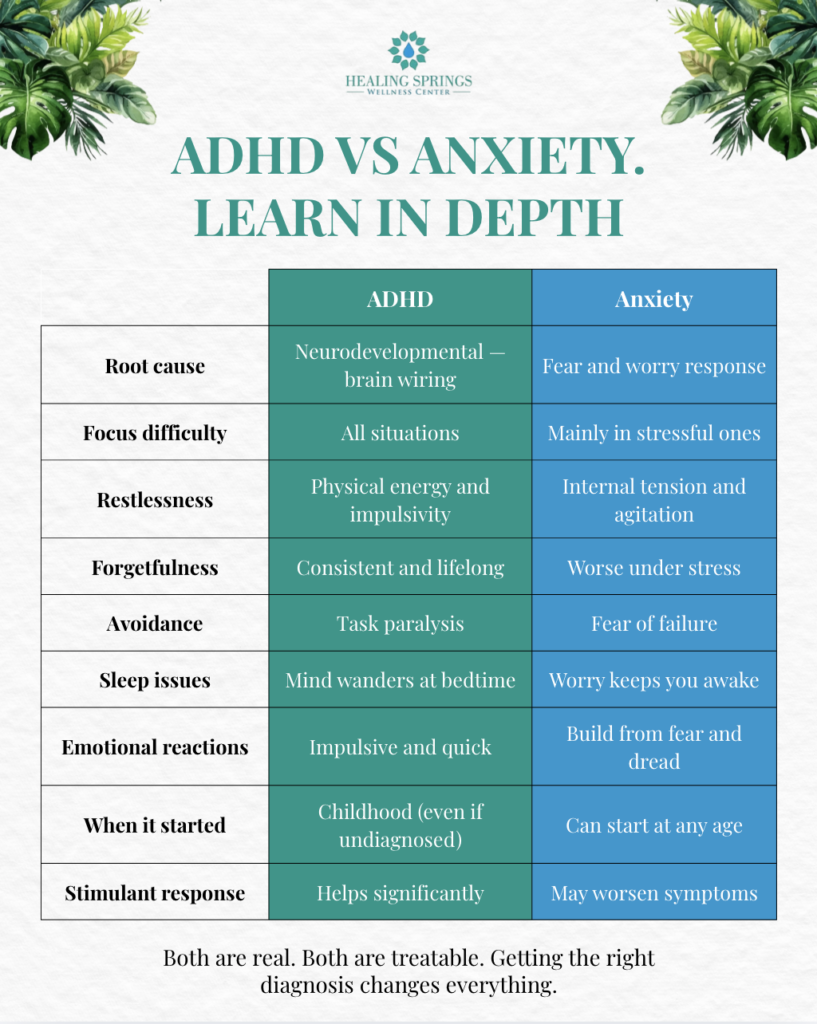
ADHD vs anxiety comes down to the root cause. If you are trying to get a clearer picture of which direction you might be in, here are the most straightforward distinguishing markers:
| Key Marker | Points More Toward ADHD | Points More Toward Anxiety |
| Focus difficulty | Present in all situations | Mainly in situations that trigger worry |
| Restlessness | Physical energy, impulsivity | Tension, internal agitation |
| Avoidance | Task paralysis, boredom | Fear of failure or negative outcome |
| Sleep issues | Hard to wind down, mind wanders | Worry keeps you awake |
| Forgetfulness | Consistent and lifelong | Variable, worse when stressed |
| Emotional reactions | Impulsive, quick, intense | Build up from fear and worry |
| Treatment response | Stimulants help focus significantly | Stimulants may worsen symptoms |
| When symptoms started | Childhood (even if undiagnosed) | Can start at any age |
Why 30% of Adults Get Misdiagnosed And What That Costs Them
Misdiagnosis between anxiety or ADHD is genuinely common; and genuinely costly. Adults experiencing ADHD symptoms frequently receive an anxiety diagnosis first, get prescribed anti-anxiety medication, and spend months or years wondering why things are not improving.
According to data published by the Mayo Clinic Press, about 30 percent of adults diagnosed with “treatment-resistant depression” have actually just been mislabeled, with underlying ADHD being the true root cause all along.
Furthermore, research published in PMC supports this significant symptom overlap, showing that the two conditions actively make each other harder to diagnose accurately.
“Misdiagnosed comorbid ADHD and anxiety may lead to treating only the symptoms of anxiety while the root of the problem: ADHD; remains untreated.”
– Katzman et al., 2017, cited in PMC
The human cost of this is real. They try different medications, different therapists, different strategies. And they keep not getting better because they are being treated for something that is not the full picture.
The wrong diagnosis can make a person feel like they are the problem and not the diagnosis.
Does ADHD Cause Anxiety?
Yes and this is one of the most important things to understand about the difference between ADHD and anxiety. ADHD can directly cause anxiety, especially in adults who have spent years struggling to keep up with demands their brain was not wired to easily meet. According to a 2025 review in Frontiers in Psychiatry, around 50 percent of adults with ADHD also have an anxiety disorder and in many cases, the anxiety developed as a secondary response to years of unmanaged ADHD. Many people even wonder, does ADHD cause anxiety, because the two often show up together and can be hard to separate.
This is why treating anxiety alone, when ADHD is the underlying cause, tends to give only partial relief. The anxiety may quiet down a little, but it keeps coming back because the thing creating it has not been addressed.
You Deserve a Diagnosis That Actually Fits
If you have been managing anxiety for a while and something still does not feel right: if treatment is helping but not quite enough; it may be time to take another look. Not because your previous care was wrong, but because getting a complete picture can open doors that partial information keeps closed.
At Healing Springs Wellness Center, we specialize in working with adults who are navigating complex mental health presentations including the overlap between anxiety and ADHD. Our team of compassionate, experienced therapists is here to help you get clarity, not just coping strategies.
You are fully seen, heard, and affirmed here. Schedule a consultation today
Frequently Asked Questions
Q: Do I have ADHD or is it just anxiety?
It could be ADHD, anxiety, or both. A licensed clinician (psychiatrist, psychologist, or trained therapist) can talk with you about your history, symptoms, and how they affect daily life, and may use questionnaires or tests to clarify the cause. Getting a clear diagnosis helps you choose the right treatments and supports.
Q: Does anxiety mask ADHD symptoms?
Yes, it can. Anxiety may make ADHD symptoms harder to notice at first.Tracking when symptoms happen, how long they last, and whether they appear across different settings helps clinicians tell them apart.
Q: What is the anxious ADHD type?
It means ADHD and anxiety happening together. You may feel distracted, overwhelmed, and worried at the same time. These conditions interact: ADHD can increase stress and create situations that trigger anxiety, while anxiety can worsen concentration and motivation. Treatment usually targets both problems together, using therapy, skills training, and sometimes medication.
Q: Can ADHD be misdiagnosed as anxiety?
Yes. A lot of people with ADHD are first treated for anxiety. Because some outward signs (trouble focusing, restlessness, sleep issues) look similar, clinicians sometimes treat the obvious anxiety first. If ADHD underlies those symptoms, anxiety-focused treatment may help some areas but leave other problems unchanged. If progress is limited, or symptoms have been lifelong and present in many settings, it’s worth asking for an ADHD evaluation or second opinion.
Q: Is it ADHD or anxiety and how do I know?
ADHD usually shows up in many situations, not just stressful ones. Anxiety often gets stronger when worry or pressure goes up. A helpful step is to write down when symptoms occur, what makes them better or worse, and any history of similar problems. Share this record with a clinician for a clearer diagnosis.
Q: What are the most obvious differences between ADHD and anxiety?
ADHD is more about attention, focus, and follow-through whereas anxiety is about fear, worry, and feeling on edge. That said, they overlap: anxiety can make attention worse, and ADHD can increase worry about performance. If you notice signs from both lists, consider an evaluation for co-occurring conditions so treatment can address each one.