
High Functioning Anxiety: 11 Signs You’re Not “Just Driven” (And How EMDR Helps in 2026)

Discover what high functioning anxiety is, 11 common signs, internal anxiety attacks, and how EMDR may help address underlying anxiety patterns.

You meet every deadline. You are the reliable one. You show up early, plan ahead, and always have a backup plan for your backup plan.

From the outside, it looks like a drive. Like ambition. Like you have it together in ways most people do not.

But inside? It is a different story entirely.

Inside, there is a voice that never stops. An inability to sit still without feeling guilty. A gnawing sense that even when everything is fine, something is about to go wrong. 

This is high functioning anxiety, and it is one of the most misunderstood, underdiagnosed, and quietly exhausting experiences a person can live with. Because it looks like success, it rarely gets treated. And because it rarely gets treated, it gets worse.

This guide breaks down exactly what high functioning anxiety is, the 11 signs that separate it from simply being driven, what an internal anxiety attack is, and why EMDR is proving to be one of the most effective treatments available; not just for managing it, but for actually healing the root of it.

What Is High Functioning Anxiety?

High functioning anxiety means you live with real, chronic anxiety; but still show up, perform, and look completely fine to everyone else.

It is not an official diagnosis. But it is very real.

Most anxiety slows people down. This kind pushes you to do more, prepare more, take on more. The anxiety becomes fuel. But that fuel eventually burns you out.

According to the Anxiety and Depression Association of America (ADAA), anxiety disorders affect 40 million adults in the US every year and many of them keep functioning normally while struggling on the inside, often for years without support.

“An individual with high-functioning anxiety may appear calm on the outside but feel very anxious internally. These individuals may try to mask their symptoms by taking control of the situation.” : Dr. Adam Borland, PsyD, Cleveland Clinic

What Does High Functioning Anxiety Look Like?

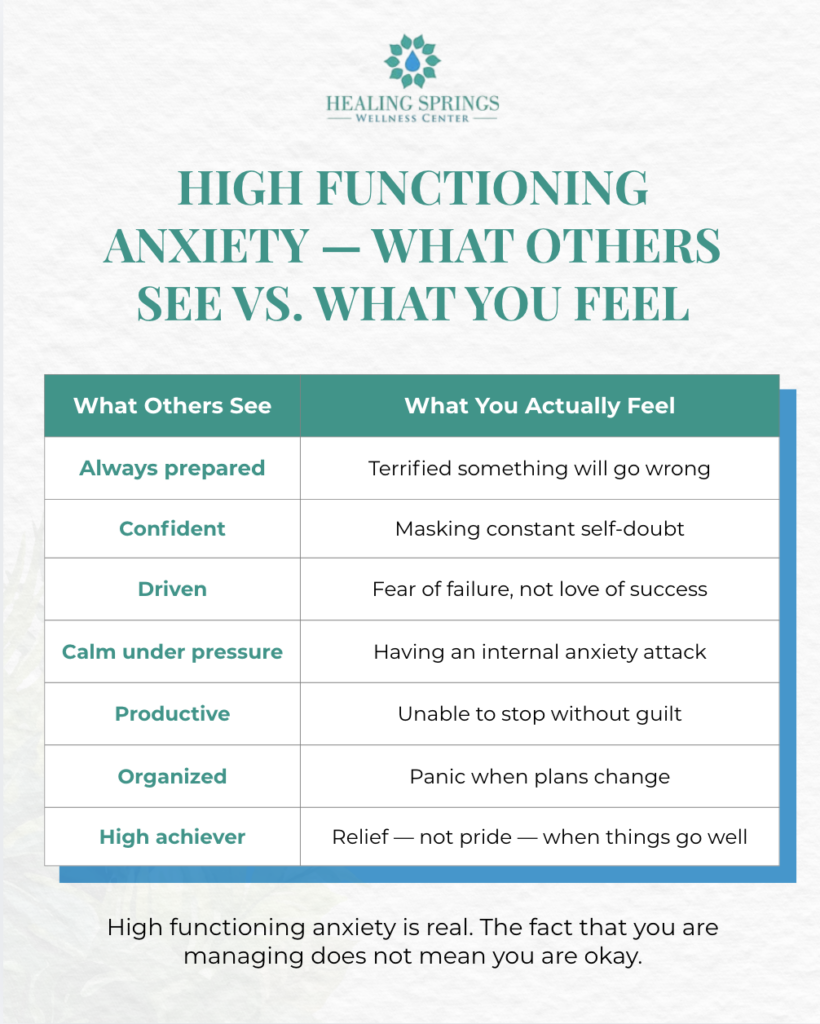
Understanding what high functioning anxiety looks like requires looking at two different pictures at the same time : what the world sees, and what the person is actually experiencing. 

What Others See What You Are Actually Experiencing
Reliable, always prepared Terrified of what happens if you are not
Confident and in control Masking constant self-doubt
High achiever Driven by fear of failure, not love of success
Calm under pressure Having an internal anxiety attack while appearing fine
Busy and productive Unable to stop because stopping feels dangerous
Punctual and organized Panic when anything deviates from the plan


This gap – between the external performance and the internal experience; is what makes high functioning anxiety so easy to miss. It looks like a personality trait but feels like a survival strategy.

11 Signs of High Functioning Anxiety (Not Just Being Driven)

These signs of high functioning anxiety are the ones that tend to get dismissed or rationalized as normal. Read through them honestly; not as traits to be proud of, but as signals worth taking seriously.

  1. Your brain feels like it never really turns off, making breaking the cycle of overthinking feel almost impossible without the right support.
You replay conversations, plan ahead, and think about everything before bed.
  2. You feel driven by fear more than success.
Finishing something feels more like relief than pride.
  3. You may have anxiety on the inside that others cannot see.
Your body feels panicked, even if you look calm.
  4. Saying no feels very hard.
You feel guilty and overthink it, so you say yes too often.
  5. You look calm while feeling overwhelmed inside.
People may not realize how much you are carrying.
  6. Perfectionism may be a coping tool.
It can feel like if everything is perfect, nothing can go wrong.
  7. Stress shows up in your body.
You may get headaches, tight muscles, stomach issues, or constant fatigue.
  8. You feel a strong need to stay in control.
Delegating or dealing with change can feel very uncomfortable.
  9. It is hard to stay fully present.
Even during good moments, your mind may drift to what is next.
  10. You feel tired in a way sleep does not fix.
It is the exhaustion of being on alert for too long.
  11. Rest can feel undeserved.
Staying busy may feel safer than slowing down.

What Is an Internal Anxiety Attack?

An internal anxiety attack is when your body goes into full panic mode but nobody around you can tell.

Your heart is racing. Your chest feels tight. You feel a sudden sense that something is wrong. But your face is calm. Your voice is steady. You look completely fine.

And for someone with high functioning anxiety, this can happen several times a day. Without anyone knowing.

If you want to know the the difference between a panic attack vs anxiety attack this guide can be helpful.

How EMDR Helps High Functioning Anxiety; Not Just Manage It, But Heal It

For many people with high functioning anxiety, the root is a nervous system that learned to stay on high alert and never learned to stop.

This is where EMDR therapy for anxiety may help by addressing the experiences and nervous-system patterns that continue fueling chronic distress.

EMDR (Eye Movement Desensitization and Reprocessing) helps the brain safely access and process the core experiences that created these long-standing survival patterns. Rather than requiring you to talk through every detail, EMDR utilizes structured bilateral stimulation such as guided eye movements, rhythmic taps, or tones to activate the brain’s natural healing process. That helps the brain reprocess upsetting memories so they lose their emotional intensity and stop fueling everyday anxiety. 

You Do Not Have to Keep Running on Empty

If high functioning anxiety has been running your life; if you are exhausted by your own success, if the internal noise has been going for years, if you have never found a treatment that actually reached the root of it; EMDR may be the thing you have been looking for.

At Healing Springs Wellness Center, we offer EMDR Intensives specifically designed for high-achieving individuals living with chronic anxiety. You are fully seen, heard, and affirmed here. Schedule a consultation today.

Authoritative Resources

If you would like to learn more from trusted mental health sources, these organizations provide reliable, research-backed information:

Frequently Asked Questions

Q: Is High Functioning Anxiety real?

Yes. It is a real and recognized experience. Most people with high functioning anxiety meet the criteria for an anxiety disorder; they just look fine on the outside, so it often goes undiagnosed for years.

Q: What are the symptoms of high-functioning anxiety?

The most common signs include:

  • Chronic overthinking, 
  • Perfectionism driven by fear, 
  • Inability to rest without guilt, 
  • Physical tension like headaches and tight jaw, 
  • Persistent exhaustion 

all while continuing to function normally on the outside.

Q: How do you treat high-functioning anxiety?

The most effective treatments for high functioning anxiety include 

  • Cognitive Behavioral Therapy (CBT), which addresses thought patterns; 
  • EMDR (Eye Movement Desensitization and Reprocessing), which addresses the nervous system roots of anxiety; and 
  • Mindfulness-based approaches for regulation. 

EMDR is particularly effective because it works at the neurological level by helping the brain rewire its anxiety response rather than just managing the symptoms. 

Q: Is high-functioning anxiety a form of ADHD?

No, they are different conditions, though they share some symptoms like restlessness and difficulty focusing. ADHD comes from differences in brain wiring. High functioning anxiety comes from chronic worry and stress. A licensed clinician can tell them apart, because the treatment for each is different.

Q: What are the 5 warning signs that someone is chronically stressed?

Five reliable indicators of chronic stress that often overlap with high functioning anxiety

  1. Persistent physical tension (especially in the jaw, neck, and shoulders), 
  2. Sleep that does not feel restorative, 
  3. Emotional reactivity disproportionate to the situation, 
  4. Difficulty making decisions or concentrating, and 
  5. A consistent sense of dread or impending difficulty even when circumstances are stable.

 If these have been present for more than a few weeks, they warrant professional attention.

Q: Why is my anxiety so high even when nothing is wrong?

Because anxiety does not always need a trigger. If your nervous system learned early on to stay on alert through stress, trauma, or repeated hard experiences; it keeps doing that even when the danger is gone. It is a nervous system pattern. And it can be treated.

Q: Does anxiety make you feel high?

Sometimes, yes. The adrenaline that comes with anxiety can feel like a boost; more alert, more energized, more “on.” For people with high functioning anxiety, this can feel like productivity. But over time, running on that adrenaline burns the nervous system out completely.

High Functioning Anxiety: 11 Signs You’re Not “Just Driven” (And How EMDR Helps in 2026)

You meet every deadline. You are the reliable one. You show up early, plan ahead, and always have a backup plan for your backup plan.

From the outside, it looks like a drive. Like ambition. Like you have it together in ways most people do not.

But inside? It is a different story entirely.

Inside, there is a voice that never stops. An inability to sit still without feeling guilty. A gnawing sense that even when everything is fine, something is about to go wrong. 

This is high functioning anxiety, and it is one of the most misunderstood, underdiagnosed, and quietly exhausting experiences a person can live with. Because it looks like success, it rarely gets treated. And because it rarely gets treated, it gets worse.

This guide breaks down exactly what high functioning anxiety is, the 11 signs that separate it from simply being driven, what an internal anxiety attack is, and why EMDR is proving to be one of the most effective treatments available; not just for managing it, but for actually healing the root of it.

What Is High Functioning Anxiety?

High functioning anxiety means you live with real, chronic anxiety; but still show up, perform, and look completely fine to everyone else.

It is not an official diagnosis. But it is very real.

Most anxiety slows people down. This kind pushes you to do more, prepare more, take on more. The anxiety becomes fuel. But that fuel eventually burns you out.

According to the Anxiety and Depression Association of America (ADAA), anxiety disorders affect 40 million adults in the US every year and many of them keep functioning normally while struggling on the inside, often for years without support.

“An individual with high-functioning anxiety may appear calm on the outside but feel very anxious internally. These individuals may try to mask their symptoms by taking control of the situation.” : Dr. Adam Borland, PsyD, Cleveland Clinic

What Does High Functioning Anxiety Look Like?

Understanding what high functioning anxiety looks like requires looking at two different pictures at the same time : what the world sees, and what the person is actually experiencing. 

What Others See What You Are Actually Experiencing
Reliable, always prepared Terrified of what happens if you are not
Confident and in control Masking constant self-doubt
High achiever Driven by fear of failure, not love of success
Calm under pressure Having an internal anxiety attack while appearing fine
Busy and productive Unable to stop because stopping feels dangerous
Punctual and organized Panic when anything deviates from the plan


This gap – between the external performance and the internal experience; is what makes high functioning anxiety so easy to miss. It looks like a personality trait but feels like a survival strategy.

11 Signs of High Functioning Anxiety (Not Just Being Driven)

These signs of high functioning anxiety are the ones that tend to get dismissed or rationalized as normal. Read through them honestly; not as traits to be proud of, but as signals worth taking seriously.

  1. Your brain feels like it never really turns off, making breaking the cycle of overthinking feel almost impossible without the right support.
You replay conversations, plan ahead, and think about everything before bed.
  2. You feel driven by fear more than success.
Finishing something feels more like relief than pride.
  3. You may have anxiety on the inside that others cannot see.
Your body feels panicked, even if you look calm.
  4. Saying no feels very hard.
You feel guilty and overthink it, so you say yes too often.
  5. You look calm while feeling overwhelmed inside.
People may not realize how much you are carrying.
  6. Perfectionism may be a coping tool.
It can feel like if everything is perfect, nothing can go wrong.
  7. Stress shows up in your body.
You may get headaches, tight muscles, stomach issues, or constant fatigue.
  8. You feel a strong need to stay in control.
Delegating or dealing with change can feel very uncomfortable.
  9. It is hard to stay fully present.
Even during good moments, your mind may drift to what is next.
  10. You feel tired in a way sleep does not fix.
It is the exhaustion of being on alert for too long.
  11. Rest can feel undeserved.
Staying busy may feel safer than slowing down.

What Is an Internal Anxiety Attack?

An internal anxiety attack is when your body goes into full panic mode but nobody around you can tell.

Your heart is racing. Your chest feels tight. You feel a sudden sense that something is wrong. But your face is calm. Your voice is steady. You look completely fine.

And for someone with high functioning anxiety, this can happen several times a day. Without anyone knowing.

If you want to know the the difference between a panic attack vs anxiety attack this guide can be helpful.

How EMDR Helps High Functioning Anxiety; Not Just Manage It, But Heal It

For many people with high functioning anxiety, the root is a nervous system that learned to stay on high alert and never learned to stop.

This is where EMDR therapy for anxiety may help by addressing the experiences and nervous-system patterns that continue fueling chronic distress.

EMDR (Eye Movement Desensitization and Reprocessing) helps the brain safely access and process the core experiences that created these long-standing survival patterns. Rather than requiring you to talk through every detail, EMDR utilizes structured bilateral stimulation such as guided eye movements, rhythmic taps, or tones to activate the brain’s natural healing process. That helps the brain reprocess upsetting memories so they lose their emotional intensity and stop fueling everyday anxiety. 

You Do Not Have to Keep Running on Empty

If high functioning anxiety has been running your life; if you are exhausted by your own success, if the internal noise has been going for years, if you have never found a treatment that actually reached the root of it; EMDR may be the thing you have been looking for.

At Healing Springs Wellness Center, we offer EMDR Intensives specifically designed for high-achieving individuals living with chronic anxiety. You are fully seen, heard, and affirmed here. Schedule a consultation today.

Authoritative Resources

If you would like to learn more from trusted mental health sources, these organizations provide reliable, research-backed information:

Frequently Asked Questions

Q: Is High Functioning Anxiety real?

Yes. It is a real and recognized experience. Most people with high functioning anxiety meet the criteria for an anxiety disorder; they just look fine on the outside, so it often goes undiagnosed for years.

Q: What are the symptoms of high-functioning anxiety?

The most common signs include:

  • Chronic overthinking, 
  • Perfectionism driven by fear, 
  • Inability to rest without guilt, 
  • Physical tension like headaches and tight jaw, 
  • Persistent exhaustion 

all while continuing to function normally on the outside.

Q: How do you treat high-functioning anxiety?

The most effective treatments for high functioning anxiety include 

  • Cognitive Behavioral Therapy (CBT), which addresses thought patterns; 
  • EMDR (Eye Movement Desensitization and Reprocessing), which addresses the nervous system roots of anxiety; and 
  • Mindfulness-based approaches for regulation. 

EMDR is particularly effective because it works at the neurological level by helping the brain rewire its anxiety response rather than just managing the symptoms. 

Q: Is high-functioning anxiety a form of ADHD?

No, they are different conditions, though they share some symptoms like restlessness and difficulty focusing. ADHD comes from differences in brain wiring. High functioning anxiety comes from chronic worry and stress. A licensed clinician can tell them apart, because the treatment for each is different.

Q: What are the 5 warning signs that someone is chronically stressed?

Five reliable indicators of chronic stress that often overlap with high functioning anxiety

  1. Persistent physical tension (especially in the jaw, neck, and shoulders), 
  2. Sleep that does not feel restorative, 
  3. Emotional reactivity disproportionate to the situation, 
  4. Difficulty making decisions or concentrating, and 
  5. A consistent sense of dread or impending difficulty even when circumstances are stable.

 If these have been present for more than a few weeks, they warrant professional attention.

Q: Why is my anxiety so high even when nothing is wrong?

Because anxiety does not always need a trigger. If your nervous system learned early on to stay on alert through stress, trauma, or repeated hard experiences; it keeps doing that even when the danger is gone. It is a nervous system pattern. And it can be treated.

Q: Does anxiety make you feel high?

Sometimes, yes. The adrenaline that comes with anxiety can feel like a boost; more alert, more energized, more “on.” For people with high functioning anxiety, this can feel like productivity. But over time, running on that adrenaline burns the nervous system out completely.

Relevant Posts