A breakup can shake you to your core. For some, it might be the right decision, yet the grief, confusion, and sense of loss that follow can still feel overwhelming. You might start questioning who you are, what you’re worth, and where to go from here.
A relationship ending doesn’t mean you failed or weren’t enough; it simply means a chapter has closed, and you’re allowed to feel whatever you’re feeling. It’s normal to feel sad, confused, or even relieved, and your feelings are valid, not too much.
Many people are told to “stay strong” and move on quickly, but real strength is allowing yourself to grieve, heal, and ask for help when you need it. You’re not weak for hurting; you’re human, and this is part of your healing journey.
Whether you’re looking for breakup counselling to process immediate grief or therapy for getting over an ex, the goal remains the same: reconnecting with your real self. And you do not have to face it all alone.
Why Breakups can be very emotional
Breakups are more than just the loss of a relationship. People often experience the loss of an identity, shared dreams, and a sense of belonging. The emotional pain of heartbreak is real; even when the decision was right.
Breakups can be very emotional because they don’t just end a relationship—they shift your whole world. You might suddenly feel like you’re losing not just a partner, but your daily routine, your sense of safety, and even parts of your identity. It’s normal to feel deeply hurt, confused, or even shocked.
Breakups often trigger deep attachment wounds; feelings of being abandoned, rejected, or not “good enough” which can make the pain feel much bigger than just losing a relationship.
Therapy for breakup and heartbreak therapy can help you make sense of these intense emotions instead of drowning in them alone. Instead of pushing your feelings down, these spaces let you explore why it hurts so much, what the relationship meant to you, and how to
Heartbreak therapy is not just about processing heartache, it’s also about rediscovering yourself. In this digital world, online therapy for breakup has become a valuable resource for people who feel reluctant to share their feelings to people .
Seeking heartbreak therapy can help you navigate emotional and psychological shifts.
Common emotional feelings after a breakup include:
- Grief and sadness:
After a breakup it’s normal to feel deep sadness, like a real loss. You might cry more, feel emotionally heavy, or miss the person even if the relationship wasn’t healthy. It’s like mourning a chapter of your life; not weakness, just part of healing.
- Anger or relief:
You might feel angry about how things ended, promises that weren’t kept, or how you were treated. At the same time, you might feel relief, especially if the relationship was stressful, dramatic, or one‑sided. Both anger and relief are valid; they show you’re processing what really happened.
- Self-doubt and low self-worth:
A breakup can make you question yourself: “Was I not enough?”, “Did I mess up?”, “Will anyone else want me?” These thoughts are common, but they don’t mean the truth is “you’re not enough.” It often reflects hurt and insecurity, not reality.
- Loneliness and isolation:
Even if the relationship was toxic, you might still feel lonely without that person in your daily life. You may miss simple things like texting, cuddling, or just having someone around. It’s normal to feel isolated, especially if you shared spaces, friends, or routines with them.
- Confusion or disorientation:
Suddenly your future plans, daily routines, and relationship identity change, and that can feel confusing or like the ground shifted under you. You might ask, “What now?” or “Who am I without this person?” This confusion is part of adjusting to a new normal.
All of these are normal. These feelings are not always linear. You may experience multiple emotions simultaneously or cycle through them.
Eventually, what matters is how you move through them and you don’t have to do it alone.
Breakup counselling provides a structured process to overcome these emotions without judgement.
How Therapy helps process a Breakup
Therapy offers a safe, non-judgmental space to understand what you’re feeling and explore the reason behind it. It helps you find the clarity and professional support to move forward with intention. People with busy schedules or who prefer a private environment, our online therapy for breakup options can help them.
Here’s what therapy for breakup can help you work through:
- Processing Grief Without Rushing It
Grief has its own timeline. After a breakup, emotions can feel overloaded. Better breakup therapy helps you name your feelings fully without getting stuck in them.
- Understanding Relationship Patterns
Every relationship teaches us something about ourselves – our needs, fears and blind spots. Therapy for getting over an ex helps you see these patterns clearly and replace them with more grounded, realistic perspectives. Instead of blaming yourself, you learn how to respond with more self‑awareness and healthier choices in the future.
- Rebuilding your identity
When a relationship ends, it’s easy to feel like losing a piece of yourself. Therapy helps you rediscover who you are outside of that relationship; your core values, your passion, and your personal strengths list. This stage isn’t about finding someone new; it’s about coming back home to yourself so you don’t rely on another person to define your worth.
Therapy approaches that support breakup recovery
Breakup therapy isn’t just about “getting over someone”; it’s about healing your emotions, understanding what happened, and relearning how to feel safe in your own life. Several therapy approaches work well for this, each offering a different way to process your pain and build strength. Therapy for a breakup is more than just processing heartache. It’s about understanding your patterns, evaluating your personal strengths, and building a new life that feels complete again.
- Cognitive Behavioral Therapy (CBT)
CBT helps you notice the thoughts that keep you stuck after a breakup like “I’m not worthy of love” or “It was all my fault.” A therapist helps replace such thoughts with more balanced, realistic and validating thoughts. This reduces overthinking, self‑blame, and anxiety, so you can start making calmer, clearer choices while going forward in life.
- Emotion‑Focused Therapy (EFT)
EFT focuses on naming and working through the emotions you feel after a breakup such as grief, anger, confusion, loneliness instead of pushing them away. It helps you understand where these feelings originate from (your attachment needs, past relationships, or family patterns) and how to express them in healthier ways instead of numbing, hiding, or exploding.
- Attachment‑based therapy
If you tend to feel depressed, anxious, or suddenly distant after a breakup, attachment‑based therapy helps you understand your attachment style and how it shaped the relationship that you had in your past. You’ll explore how early experiences with caregivers affect the way you love and lose today, so you can form more secure, balanced connections in the future.
- Narrative therapy
Narrative therapy helps you rewrite the story you tell yourself about the breakup. Instead of feeling like a “failed relationship” or “heartbreak victim,” you begin to see it as a chapter that taught you about your needs, boundaries, and self‑worth. This shift helps you feel more in control of your life and less stuck in the past.
- Mindfulness‑based approaches
Mindfulness practices, often used in therapies like Mindfulness‑Based Cognitive Therapy (MBCT), help you notice your thoughts and feelings without drifting apart. You learn to pause before reacting, and come back to the present moment. This is especially helpful when you keep replaying texts, memories, or “what if I was better” scenarios.
Rediscovering your Strengths after a Breakup
One of the most transformative parts of post-breakup therapy is re-finding the strength and weakness list of oneself – more precisely one’s strengths.
When we’re in pain, it’s easy to forget what we’re capable of. Through consistent breakup counselling, one can easily overcome grief and move forward with clarity in life.
Knowing your strengths words resilience, empathy, creativity, loyalty helps you rebuild your self-concept and move forward with confidence rather than self-doubt.
Self awareness is the most powerful gift of therapy for breakup.
In therapy for breakup, self-awareness is like – being able to acknowledge your emotions without the fear of judgement, responding calmly, making decisions with clarity instead of pressure.
When to consider therapy after a breakup
After a breakup, it’s normal to feel sad, confused, or drained—but sometimes the pain doesn’t fade on its own and starts to affect your daily life. Talking to a therapist isn’t about being “too sensitive”; it’s about giving yourself support so you can heal instead of staying stuck. If your emotions feel overwhelming or are stopping you from moving forward, therapy can be a healthy next step.
Here are simple signs it may be time to consider therapy after a breakup:
- You feel low, empty, or numb most days, and it’s hard to enjoy things that used to matter to you earlier
- You’re crying, overthinking, or replaying conversations so often that it’s hard to focus on your daily routine
- Changes in Sleep and appetite; you either can’t sleep or sleep too much, or you’re not eating regularly.
- You isolate yourself, cancel plans, or avoid people because you feel too sensitive or “not okay.”
- You notice strong anger, irritability, or thoughts of hurting yourself or not wanting to live anymore.
- You keep repeating similar relationship patterns or feel confused about why the same problems keep happening.
- You feel unable to set boundaries, such as going back to your ex, stalking social media, or holding on to “just in case” hope.
Friends or family tell you they’re worried but you still feel alone or like no one truly gets it.
If several of these feel familiar, reaching out for therapy especially therapy for breakup or online therapy for breakup can help you process your feelings in a safe, structured way and start feeling like yourself again.
Online therapy for breakup
For many people, the idea of sharing grief while sitting in a therapist’s office feels too much. Online therapy for breakup offers the same quality of professional support including more privacy and less invasion.
Through video or phone sessions, you can work with a therapist experienced in breakup counseling who understands how grief, attachment, and self‑worth shift after a relationship ends.
A good online therapy for breakup space helps you slow down instead of rushing to “get over it.” You can unpack your emotions, understand what drew you to your ex, and recognize patterns that keep repeating in your relationships.
Instead of being told to “move on” or “stay strong,” you get support to feel your feelings, grieve your loss, and slowly rebuild your sense of self. Virtual sessions can reduce shame or pressure, especially for people who worry about being seen walking into a clinic or judged in their community. Whether you’re struggling with sleep, overthinking, or just feeling empty, therapy for breakup and online therapy for breakup can help you process your experience and move toward healing with more clarity and self‑care.
What healing through therapy looks like
Healing through therapy after a breakup doesn’t happen in one straight line, but you do begin to feel like yourself again. At first, sessions may feel heavy as you talk about your hurt, confusion, and grief, but slowly the memories start fading away and drift apart. Over time, you may notice that you’re thinking about “that person” less, worrying less about what they’re doing, and feeling more present in your own life.
- You start to cry less often and sleep more calmly instead of lying awake replaying conversations and situations
- You’re less harsh and more kind towards yourself, and talk like you’d speak to a close friend who’s hurting.
- You begin to see patterns: why you stayed in the relationship, how you ignored red flags, and what you truly need in love.
- You stop checking their social media, their page, or texting them and focus more on your life
- You feel more interested in your own life again hobbies, friendships, goals instead of feeling like your identity was over after the relationship.
- You can talk about your experience without instantly shutting down, freezing, or needing to escape the topic.
- You still feel sad on certain days, but it doesn’t stretch you out for weeks anymore; it feels like part of your story, not your whole life.
- You trust your judgment more and feel less afraid of being alone or “never finding love again.”
With the right support whether in person or through online therapy for breakup healing often looks less like “forgetting them” and more like returning to yourself, smarter, clearer, and more intentional about who you choose to love and how you let others love you.
You are more than this Breakup
Healing after a breakup is not about forgetting someone. It’s about remembering yourself. Your identity, right to feel happy, passion didn’t disappear when the relationship ended; they’re still here, waiting to be reclaimed.
Choosing the better breakup therapy for your journey will help you grow from your grief or experience. Whether you’re ready to start or just taking the first step by reading this, we are here. You are worthy of healing. You are worthy of happiness. You do not have to do this alone.
At Healing Springs Wellness Center, we are here to walk with you. Reach out today to schedule a consultation and take the first step toward moving forward, with clarity, compassion, and confidence.
Frequently Asked Questions
Q: What is the best therapy for breakups?
There isn’t one “best” therapy for a breakup.
A breakup hits different layers: grief, identity loss, attachment wounds, self-worth. So the right therapy depends on what you’re struggling with most.
If the relationship involved emotional abuse or trauma, EMDR can be highly effective. If you’re struggling with recurring and unhelpful thoughts, Cognitive Behavioral Therapy (CBT) offers practical tools for overcoming. If you need to process grief in a safe and open space, person-centered talk therapy works well.
At a place like Healing Springs Wellness, our holistic trauma-informed approach would usually be personalised, not one-size-fits-all.
Q: What are tips from therapy that have massively helped people get through a breakup?
Here are a few things that help people get through a breakup:
- Stop trying to make sense of every ending – Every relationship is different and not each of them ends with clarity. It’s normal to have unanswered questions.
- Learn to pause before reacting to emotion – Breakup counselling helps you stretch that pause when you feel the urge to text, revisit old conversations.
- Healing is not always linear – There can be moments when you feel okay and then not okay again. None of that justifies your personality.
- Acknowledge grief, without rushing it away – People who heal well don’t rush to feel better. Involving in heartbreak therapy can help sit with that grief safely.
Q: What is the 3-3-3 rule for a breakup?
This isn’t a formal therapy model, but it’s often used as a gentle structure for early healing:
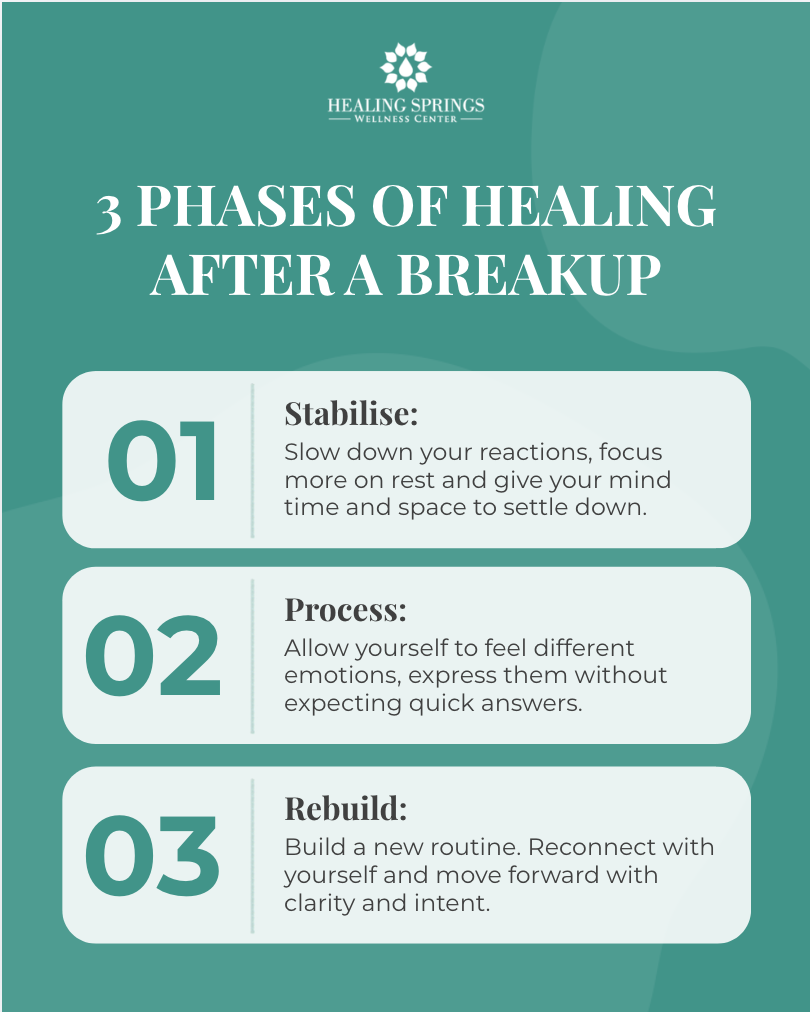
- First 3 days: Stabilise yourself (sleep, eat, reduce emotional triggers). Your nervous system needs to settle before anything else.
- Next 3 weeks: Allow emotional processing (grief, journaling, talking it out). Begin heartbreak therapy for professional support.
- Next 3 months: Rebuild routine, identity, and direction. This is where therapy for breakup helps the most.
Healing does not follow a calendar. Having structured support is necessary.
Q: What is the 65% rule of breakups?
As per the research, the 65% rule of breakup suggests that breakups happen due to unresolved patterns, not one single event.
Therapy for getting over an ex is particularly effective here as it helps you identify those recurring experiences.
So instead of focusing on a percentage, we focus on this:
“Breakups are not solely about one moment—they’re about what kept repeating and wasn’t acknowledged and changed”
Q: What is the 72-hour rule after a breakup?
It suggests giving yourself at least 72 hours of no contact or no reaction after the breakup. The reason behind this is that the first 2–3 days are usually driven by emotional shock.
Those 72 hours gently create space for your nervous system to relax before you act.
Q: What is the hardest month after a breakup?
There is no “hardest month.”
But, for a lot of people:
- The first month is intense due to shock and withdrawal
- The second month can be suprisingly heavier—because reality sinks in, and distractions fade
In therapy, we don’t label a “hardest” phase. We prepare you for waves—because healing doesn’t have a calendar..
Q: What is the 37% rule in Dating?
It suggests that an individual spends the first 37% of their dating phase going through different options and end up choosing the best available person rather than searching endlessly. In therapy, we focus more on compatibility, emotional safety and alignment.