
Self Worth: How to Rebuild Confidence After Emotional Trauma

Self worth can be deeply affected by emotional trauma. Learn how to build self worth, rebuild confidence and develop healthier self-beliefs over time.

Things to remember: 

  • Define self-worth as your internal belief that you deserve love and respect; and it is highly impacted by emotional trauma, over a period of time.
  • Losing your sense of self-worth is not a character flaw. It is often a natural response to carrying pain, burdens, and experiences that were never meant to be carried alone.
  • Rebuilding self-worth and self-esteem is possible, with the right understanding, right tools and the right support. 

Have you ever looked in the mirror and felt disconnected from the person looking back at you? Not physically, but emotionally. As though somewhere along the way, you lost touch with who you are, what you need, and what you truly deserve.

This is one of the ways emotional trauma can impact self worth.

It does not always arrive loudly or dramatically. Sometimes, it develops quietly over time through experiences of being dismissed, criticized, overlooked, misunderstood, or unheard by the very people who were meant to provide safety, support, and care.

Little by little, those experiences begin to shape the way you see yourself. Without even realizing it, you may start to internalize the messages you received from others. The criticism becomes your inner voice. The rejection becomes your self-doubt. 

The good news is that what was learned can also be unlearned. Healing helps reconnect with the person you were before the pain that made you believe that you were not enough. This guide is here to help you out.

What is self-worth 

Before we talk about how to rebuild self worth, it is important to define self worth and understand what it actually is. Self worth is the way you view your own value as a human being. It is the quiet belief that you are deserving of love, respect, care and belonging. Not because of what you have achieved, how you look, who appreciates you. But just because you exist. It comes from recognizing that your value exists because you exist. 

You are a human being with needs, feelings, strengths, flaws and unique experiences; and that alone makes you worthy of dignity, compassion, respect and love.

Healthy self worth makes you realise that you no longer have to constantly prove that you matter. You begin to understand that your worth is not a reward for becoming someone else. It is something that has been yours all along.

Self worth and self-esteem are often used interchangeably, however, they are not the same thing. 

Self-esteem is how you feel about your capabilities, performance and competence in different areas of life. It’s tied to how you believe you’re doing – your successes, your failures and achievements. 

Self-esteem may increase when you: 

  • Succeed at a task, 
  • Receive appreciation or recognition, 
  • Feel confident in your abilities or 
  • Experience positive outcomes. 

Self-esteem may decrease when you: 

  • Make mistakes, 
  • Face rejection, 
  • Struggle in relationships or 
  • Encounter setbacks. 

Because self esteem is connected to our experiences and our beliefs, it tends to fluctuate. 

In contrast, self-worth is not dependent on success, appreciation, productivity, or outcomes. It is the deeper understanding that your value as a human being remains constant, even during different phases of struggle, failure, disappointment, or uncertainty. 

Trauma can make that understanding difficult to access. Over time, it convinces them that their value depends on what they do, how well they perform, or how others respond to them. 

And this is often where healing begins by reconnecting with something that was there long before the wounds appeared. 

How emotional trauma affects self-worth

Emotional trauma does not always originate from a single dramatic event. It may be years of emotional criticism or invalidation. It may be growing up with a caregiver who was emotionally unavailable. It may be a relationship that gradually makes you feel insecure. It may be repeatedly having your feelings dismissed until you stopped expressing them. 

Regardless of how it developed, trauma can influence the way you perceive your value. Some common signs of trauma-related wounds to self-worth include: 

  • You feel like you are never quite enough, no matter how hard you try
  • You apologize constantly, even when you have done nothing wrong
  • You struggle to receive a compliment without immediately dismissing it
  • You constantly prioritize the needs of others while neglecting your own, often without realizing you’re doing it. 
  • You carry a deep sense of self-criticism that you cannot fully explain
  • You have a hard time believing that good things or good people will actually stay in youtube life

These responses are often misunderstood as personality traits. None of this is who you are. They reflect what you learned to do in order to cope, adapt and survive. And it deserves real care and support through compassionate healing work. 

Why Rebuilding Self-Worth Matters More Than You Think

One of the most important things to understand about self-worth is that it influences nearly every area of your life. 

The way you see yourself shapes, the relationship relationships, you enter the boundaries, you set the opportunities you pursue, and the way you respond to difficulties, mistakes and setbacks. It affects how you communicate your needs, how you care for yourself, and what you believe you deserve from others. 

In many ways, your internal sense of worth becomes the lens through which you experience the world. 

When that self-worth is damaged by emotional drama, chronic criticism, rejection, disappointment or difficult life experiences, its effects extend far beyond self-confidence alone. 

You may find yourself 

  • Staying in unhealthy relationships  that confirm the negative things you already believe about yourself
  • Settling for less than you deserve in love, in work, in everyday life because asking for more feels uncomfortable or undeserved.
  • Struggling to ask for what you genuinely need or build healthy boundaries
  • Carrying a constant low-level anxiety, because deep down you feel like you are always one mistake away from being rejected or abandoned

Over time, these patterns can affect emotional well-being, relationship, goals, career growth, and overall mental health. 

This is why rebuilding self-worth becomes a fundamental part of emotional, healing and trauma recovery. 

Stronger the sense of worth, better the choices. You may build healthier boundaries, adapt to fulfilling relationships, trust yourself, and move ahead in life with greater confidence and self compassion.

When you begin to recognise your inherent value and the world around you, you can begin to change in meaningful ways. 

Signs Your Self-Worth May Have Been Affected by Trauma

The impact of low self-worth is hard to see from the inside especially when these patterns have been present for a long time. What feels normal may actually be a response to past emotional wounds. 

Here are some signs worth paying attention to with gentleness, not self-judgment:

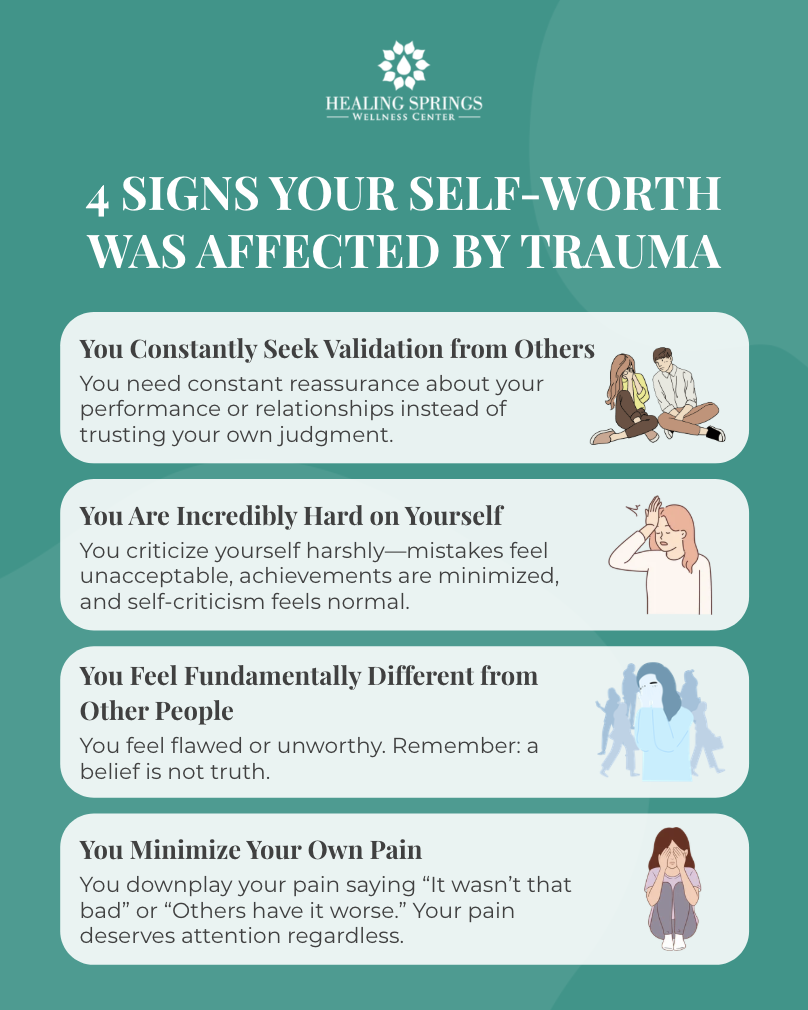
  • You constantly seek validation from others

Do you frequently need assurance from people that you did a good job, or that someone is not upset with you?

When self-worth has been weakened by trauma, external validation can begin to feel like the primary source of security. Rather than trusting your own judgement, you may rely on other people’s approval to determine how you feel about yourself. This is one of the most common signs of low self-worth after trauma.

  • You are incredibly hard on yourself

Rebuilding self-worth often begins with practicing self-compassion instead of self-criticism. Mistakes feel unacceptable. Imperfections feel like proof of failure. Achievements are minimized, while shortcomings receive intense attention..

Over time, the self-critical inner dialogue can become so familiar that it feels normal. 

  • You feel fundamentally different from other people

You may carry a persistent sense that something about you is different, missing or flawed. 

Perhaps it feels like you were left, trying to figure it out on your own, whereas everyone else learned how to navigate life with confidence, connection and belonging. People who survived constant trauma, describe feeling disconnected from others in this way. Trauma can create strong beliefs about being unworthy, unlovable, or less deserving than those around you. 

These beliefs can feel convincing because they have been reinforced over time. However, one thing that needs to be understood is that: a belief is not the same thing as a truth. 

  • You minimize your own pain

One of the most common responses to emotional trauma is learning to down your own experiences.

You may find yourself saying things such as: “It wasn’t that bad.”, “Other people have been through worse”, “I shouldn’t be affected by this.”; These thoughts are way of distancing yourself from your own pain. If you regularly compare, dismiss or invalidate your experiences, it may be assigned that you learned your feelings were not important enough to be acknowledged. 

If something hurt you affected you or shaped the way you see yourself, it matters. Your pain does not need to meet a certain threshold to deserve attention; instead, it deserves to met with understanding 

How to Build Self-Worth After Emotional Trauma

Rebuilding self-worth is not about repeating affirmations until you feel better. While affirmations can be helpful for some people, lasting change often comes from something deeper: consistently treating yourself as someone worthy of care, respect and compassion.
If you’re wondering how to build self-worth after emotional trauma, here is how to start:

1. Acknowledge what happened

This is often the step most people skip because it can be uncomfortable. But you cannot heal what you refuse to name. Acknowledging your trauma does not mean dwelling in it or defining yourself by it. It means giving yourself permission to say: something painful occurred, that it had an impact, and that your response to it makes sense within that context. 

You might simply begin by saying:

“Something painful happened to me. It affected me, and I am allowed to heal from it.”

This single act of honest acknowledgment can be a surprisingly powerful step in rebuilding self-worth. It validates your experience without judgement and creates space for genuine emotional healing. When you define self-worth as inherent rather than earned, acknowledgement becomes the foundation for building self-esteem 

2. Challenge the stories trauma left behind

Trauma does not just hurt you in the moment — it leaves stories behind. Narratives about who you are and what you deserve. Over time, painful experiences can leave behind stories such as:
“I am too much.”

“I am not good enough.”

“I do not deserve good things.”

These stories are not the truth. They are interpretations created by a younger version of yourself who was trying to understand difficult experiences. who was doing their best to understand difficult situations. 

A key part of building an esteemed self is learning to identify these narratives and gently question them. When you define self-worth separately from these stories, you create space for self-esteem to grow based on truth and not trauma.

One helpful practice is to ask: 

“Would I speak to someone I care about this way?”

If the answer is no, consider offering yourself what you would offer them instead. Then practice extending the same compassion toward yourself. This practice directly strengthens self-esteem 

3. Practice setting limits even small ones

Setting limits is one of the most direct ways to build self-worth. Every time you honor a personal limit, communicate a need or protect your energy, you send yourself a quiet but powerful message: my needs matter.

Start small. You do not need to have a difficult family conversation on day one. You can start by not answering a text when you are exhausted, or protecting one hour for yourself each week. 

Each time you honor your needs, you strengthen your sense of self-worth. This is critical because self-esteem grows when your actions align with your values. When you define self-worth as your right to have boundaries, setting limits becomes an act of honoring that definition. 

4. Act worthy before you feel worthy

This is one of the most important things to understand about how to build self-worth: the feeling of worthiness tends to follow the action, not the other way around.

Many people feel that you need to feel confident or secure before you speak up. In reality, confidence frequently develops after repeated experiences of taking healthy action. This is especially true for self-esteem, which builds through consistent action and positive experiences. 

You do not need to feel completely worthy before expressing your opinion
You do not need to feel fully confident before setting a boundary.
You do not need to feel deserving before asking for support

By acting in alignment with your words, you gradually provide your mind and nervous system with new evidence about who you are and what you deserve. 

5. Reconnect with your body

Emotional trauma often creates a disconnect between mind and body. Many people describe feeling like they are watching their own life from a slight distance — present physically, but not quite inside themselves. Gentle practices like yoga, walking, breathwork, or Spending time in nature can help strengthen that connection. Even simple moments of intentional awareness can make a difference. 

Simply placing a hand on your heart, breathing slowly, or checking in with how your body feels can become meaningful acts of self-care.. 

Your body has carried you through difficult experiences, treating it with kindness is an expression of self-worth

6. Surround yourself with people who reflect your worth back to you

You cannot fully rebuild self-worth in isolation especially when trauma happened in relationships. Healing often requires experiencing healthier forms of connection. Supportive relationships cannot create your worth, but they can help you reconnect with it. Seek out people who listen, respect your boundaries, communicate honestly and make you feel valued as your authentic self. 

After spending time with someone, consider asking yourself:
“Do I feel more connected to myself or less?”

The answer may offer important insight into which relationships support your healing, and which ones undermine it. 

7. Seek professional support

Some wounds run deeper than self-help alone can reach. If your self-worth has been significantly impacted by childhood trauma or emotional wounds, professional support can help, emotional abuse, prolonged neglect, or toxic relationships working with a trauma-informed therapist can make a profound difference.

Approaches like EMDR (Eye Movement Desensitization and Reprocessing) are specifically designed to help your brain reprocess painful memories so they stop shaping how you see yourself today. Many people describe therapy as an opportunity to finally understand themselves with greater clarity, compassion, and perspective. Healing does not erase the past. It helps loose the grip the past may still have on your present day sense of self. 

And for many people, that shift becomes the beginning of rebuilding healthy self-esteem, stronger self-worth, and more compassionate relationships with themselves. 

Self Worth Quotes for the Hard Days

Sometimes, on the hard days, the right words can be a small anchor. Here are a few self-worth quotes we return to:

“You yourself, as much as anybody in the entire universe, deserve your love and affection.” — Buddha

“Your value does not decrease based on someone’s inability to see your worth.” — Unknown

“You are allowed to be both a masterpiece and a work in progress simultaneously.” — Sophia Bush

“Owning our story and loving ourselves through that process is the bravest thing we will ever do.” — Brene Brown

These are not just nice phrases. They are reminders of a truth that trauma tried to take from you. You are allowed to come back to it as many times as you need to.

What Unshakeable Self-Worth Actually Feels Like

A lot of people ask about the power of unshakeable self-worth — what it actually looks and feels like in real everyday life. Here is the honest answe: rUnshakeable self-worth doesn’t mean you never have hard days or feel insecure. You’re still human — you’ll face rejection, mistakes, and loss. But when you define self-worth correctly, these experiences no longer determine your value.

Your worth isn’t dependent on:

  • Someone responding to your message
  • A promotion or accomplishment
  • How many people choose you

Instead, you feel internal stability. Your worth stays constant even when circumstances change. You separate what happened from what it means about your value.

This is where self-esteem and healthy self-worth meet — letting you face challenges without questioning if you’re enough.

That inner stability builds through small moments of self-respect, self-awareness, and self-compassion. Each time you honor a boundary, challenge negative beliefs, or treat yourself kindly, you strengthen that foundation.

That possibility is available to you today.. 

You Deserve to Feel Whole Again

Rebuilding self-worth after emotional trauma is one of the most meaningful things you can do for yourself and for every relationship in your life. It is not selfish. It is not indulgent. It is necessary.

The journey is not linear. Some days will feel easier than others. There may be moments when old beliefs, resurface or familiar patterns return, but that does not mean you are feeling. It means you are human and healing is a process rather than a final destination.

Remember that self-worth is not something. You do not have to earn it. It exists within you now, even if it feels difficult to access. Healing happens when you begin to recognise that your worth was never lost in the first place. And perhaps this is the most important thing to remember:

What happened to you may have shaped the way you see yourself, but it does not define your value.”

Your story is still unfolding and no matter where you are today. It is never too late to build a healthy relationship with yourself, cultivate lasting self-worth and move towards a life that feels more grounded and authentic and whole. 

Frequently Asked Questions

Q: How do you build self worth and confidence after a lifetime of trauma?

Building self-worth after a lifetime of trauma is a gradual process rather than a single breakthrough moment.

It often begins with:

  1. Acknowledging that your experiences affected you
  2. Challenging negative beliefs about yourself
  3. Setting healthy boundaries
  4. Practicing self-compassion
  5. Surrounding yourself with supportive relationships

Healing does not happen all at once. It develops through small, consistent actions that help you reconnect with your value over time.

Q: How to build self worth and self-esteem?

Self-worth and self-esteem are strengthened through consistent practice rather than positive thinking alone.

Some helpful steps include:

  • Speaking to yourself with greater compassion
  • Setting and honoring personal boundaries
  • Recognizing and challenging self-critical thoughts
  • Celebrating small successes
  • Building relationships that support your well-being

Over time, these actions help create a stronger sense of confidence, self-respect, and emotional resilience. Consider professional support trauma-focused therapy, particularly EMDR, can help you heal the roots of low self-worth rather than just managing symptoms on the surface.

Q: How to regain confidence in yourself after trauma?

Regaining confidence after trauma often starts with separating your identity from your experiences.

Trauma can create beliefs such as:

“I am not good enough.”
“I am unlovable.”
“Something is wrong with me.”

While these beliefs may feel true, they are often responses to painful experiences rather than reflections of reality.

Confidence grows each time you take a small action that supports your goals, values, or well-being. Consistent action creates new beliefs about what you are capable of.

Q: What is the power of unshakeable self-worth?

Unshakeable self-worth means your sense of value is no longer entirely dependent on external validation, achievements, or approval from others.

People with healthy self-worth tend to:

  • Recover more effectively from setbacks
  • Set healthier boundaries
  • Navigate relationships with greater confidence
  • Experience less fear of rejection
  • Maintain a stronger sense of identity during difficult times

It does not mean life becomes easy. It means challenges no longer determine your worth.

Q: What are the 4 F’s of CPTSD?

The 4 F’s of Complex PTSD (CPTSD) are survival responses identified by psychologist Pete Walker to describe how people adapt to prolonged trauma:

  • Fight: Responding to stress with anger, control, or aggression
  • Flight: Responding with constant busyness, perfectionism, or an inability to slow down
  • Freeze: Responding by shutting down, dissociating, or going emotionally numb when overwhelmed
  • Fawn: Responding by people-pleasing and consistently prioritizing others’ needs over your own to avoid conflict or rejection

Most people with trauma histories have a dominant response — and often a combination. Understanding your pattern is an important step in healing, because these responses often developed as ways to stay safe in environments where simply being yourself felt too risky.

Q: What are the 5 C’s of self-esteem?

The 5 C’s of self-esteem are a framework for understanding what healthy self-worth looks like in practice:

  • Confidence — Trusting yourself to handle what life brings, even when it is hard
  • Competence — Knowing you are capable of learning, growing, and doing hard things
  • Connection — Feeling genuinely loved and valued by others
  • Character — Having a clear sense of your values and living in alignment with them
  • Contribution — Feeling that your presence and your actions make a meaningful difference

When trauma is present, one or more of these tends to be disrupted. Therapy helps you identify which areas need the most support and rebuild them gently, honestly, and at your own pace.

Self Worth: How to Rebuild Confidence After Emotional Trauma

Things to remember: 

  • Define self-worth as your internal belief that you deserve love and respect; and it is highly impacted by emotional trauma, over a period of time.
  • Losing your sense of self-worth is not a character flaw. It is often a natural response to carrying pain, burdens, and experiences that were never meant to be carried alone.
  • Rebuilding self-worth and self-esteem is possible, with the right understanding, right tools and the right support.

Have you ever looked in the mirror and felt disconnected from the person looking back at you? Not physically, but emotionally. As though somewhere along the way, you lost touch with who you are, what you need, and what you truly deserve.

This is one of the ways emotional trauma can impact self worth.

It does not always arrive loudly or dramatically. Sometimes, it develops quietly over time through experiences of being dismissed, criticized, overlooked, misunderstood, or unheard by the very people who were meant to provide safety, support, and care.

Little by little, those experiences begin to shape the way you see yourself. Without even realizing it, you may start to internalize the messages you received from others. The criticism becomes your inner voice. The rejection becomes your self-doubt. 

The good news is that what was learned can also be unlearned. Healing helps reconnect with the person you were before the pain that made you believe that you were not enough. This guide is here to help you out.

What is self-worth 

Before we talk about how to rebuild self worth, it is important to define self worth and understand what it actually is. Self worth is the way you view your own value as a human being. It is the quiet belief that you are deserving of love, respect, care and belonging. Not because of what you have achieved, how you look, who appreciates you. But just because you exist. It comes from recognizing that your value exists because you exist. 

You are a human being with needs, feelings, strengths, flaws and unique experiences; and that alone makes you worthy of dignity, compassion, respect and love.

Healthy self worth makes you realise that you no longer have to constantly prove that you matter. You begin to understand that your worth is not a reward for becoming someone else. It is something that has been yours all along.

Self worth and self-esteem are often used interchangeably, however, they are not the same thing. 

Self-esteem is how you feel about your capabilities, performance and competence in different areas of life. It’s tied to how you believe you’re doing – your successes, your failures and achievements. 

Self-esteem may increase when you: 

  • Succeed at a task, 
  • Receive appreciation or recognition, 
  • Feel confident in your abilities or 
  • Experience positive outcomes. 

Self-esteem may decrease when you: 

  • Make mistakes, 
  • Face rejection, 
  • Struggle in relationships or 
  • Encounter setbacks.

Because self esteem is connected to our experiences and our beliefs, it tends to fluctuate. 

In contrast, self-worth is not dependent on success, appreciation, productivity, or outcomes. It is the deeper understanding that your value as a human being remains constant, even during different phases of struggle, failure, disappointment, or uncertainty. 

Trauma can make that understanding difficult to access. Over time, it convinces them that their value depends on what they do, how well they perform, or how others respond to them. 

And this is often where healing begins by reconnecting with something that was there long before the wounds appeared. 

How emotional trauma affects self-worth

Emotional trauma does not always originate from a single dramatic event. It may be years of emotional criticism or invalidation. It may be growing up with a caregiver who was emotionally unavailable. It may be a relationship that gradually makes you feel insecure. It may be repeatedly having your feelings dismissed until you stopped expressing them. 

Regardless of how it developed, trauma can influence the way you perceive your value. Some common signs of trauma-related wounds to self-worth include: 

  • You feel like you are never quite enough, no matter how hard you try
  • You apologize constantly, even when you have done nothing wrong
  • You struggle to receive a compliment without immediately dismissing it
  • You constantly prioritize the needs of others while neglecting your own, often without realizing you’re doing it. 
  • You carry a deep sense of self-criticism that you cannot fully explain
  • You have a hard time believing that good things or good people will actually stay in youtube life

These responses are often misunderstood as personality traits. None of this is who you are. They reflect what you learned to do in order to cope, adapt and survive. And it deserves real care and support through compassionate healing work. 

Why Rebuilding Self-Worth Matters More Than You Think

One of the most important things to understand about self-worth is that it influences nearly every area of your life. 

The way you see yourself shapes, the relationship relationships, you enter the boundaries, you set the opportunities you pursue, and the way you respond to difficulties, mistakes and setbacks. It affects how you communicate your needs, how you care for yourself, and what you believe you deserve from others. 

In many ways, your internal sense of worth becomes the lens through which you experience the world. 

When that self-worth is damaged by emotional drama, chronic criticism, rejection, disappointment or difficult life experiences, its effects extend far beyond self-confidence alone. 

You may find yourself 

  • Staying in unhealthy relationships  that confirm the negative things you already believe about yourself
  • Settling for less than you deserve in love, in work, in everyday life because asking for more feels uncomfortable or undeserved.
  • Struggling to ask for what you genuinely need or build healthy boundaries
  • Carrying a constant low-level anxiety, because deep down you feel like you are always one mistake away from being rejected or abandoned

Over time, these patterns can affect emotional well-being, relationship, goals, career growth, and overall mental health. 

This is why rebuilding self-worth becomes a fundamental part of emotional, healing and trauma recovery. 

Stronger the sense of worth, better the choices. You may build healthier boundaries, adapt to fulfilling relationships, trust yourself, and move ahead in life with greater confidence and self compassion.

When you begin to recognise your inherent value and the world around you, you can begin to change in meaningful ways. 

Signs Your Self-Worth May Have Been Affected by Trauma

The impact of low self-worth is hard to see from the inside especially when these patterns have been present for a long time. What feels normal may actually be a response to past emotional wounds. 

Here are some signs worth paying attention to with gentleness, not self-judgment:

  • You constantly seek validation from others

Do you frequently need assurance from people that you did a good job, or that someone is not upset with you?

When self-worth has been weakened by trauma, external validation can begin to feel like the primary source of security. Rather than trusting your own judgement, you may rely on other people’s approval to determine how you feel about yourself. This is one of the most common signs of low self-worth after trauma.

  • You are incredibly hard on yourself

Rebuilding self-worth often begins with practicing self-compassion instead of self-criticism. Mistakes feel unacceptable. Imperfections feel like proof of failure. Achievements are minimized, while shortcomings receive intense attention..

Over time, the self-critical inner dialogue can become so familiar that it feels normal. 

  • You feel fundamentally different from other people

You may carry a persistent sense that something about you is different, missing or flawed. 

Perhaps it feels like you were left, trying to figure it out on your own, whereas everyone else learned how to navigate life with confidence, connection and belonging. People who survived constant trauma, describe feeling disconnected from others in this way. Trauma can create strong beliefs about being unworthy, unlovable, or less deserving than those around you. 

These beliefs can feel convincing because they have been reinforced over time. However, one thing that needs to be understood is that: a belief is not the same thing as a truth. 

  • You minimize your own pain

One of the most common responses to emotional trauma is learning to down your own experiences.

You may find yourself saying things such as: “It wasn’t that bad.”, “Other people have been through worse”, “I shouldn’t be affected by this.”; These thoughts are way of distancing yourself from your own pain. If you regularly compare, dismiss or invalidate your experiences, it may be assigned that you learned your feelings were not important enough to be acknowledged. 

If something hurt you affected you or shaped the way you see yourself, it matters. Your pain does not need to meet a certain threshold to deserve attention; instead, it deserves to met with understanding 

How to Build Self-Worth After Emotional Trauma

Rebuilding self-worth is not about repeating affirmations until you feel better. While affirmations can be helpful for some people, lasting change often comes from something deeper: consistently treating yourself as someone worthy of care, respect and compassion.
If you’re wondering how to build self-worth after emotional trauma, here is how to start:

1. Acknowledge what happened

This is often the step most people skip because it can be uncomfortable. But you cannot heal what you refuse to name. Acknowledging your trauma does not mean dwelling in it or defining yourself by it. It means giving yourself permission to say: something painful occurred, that it had an impact, and that your response to it makes sense within that context. 

You might simply begin by saying:

“Something painful happened to me. It affected me, and I am allowed to heal from it.”

This single act of honest acknowledgment can be a surprisingly powerful step in rebuilding self-worth. It validates your experience without judgement and creates space for genuine emotional healing. When you define self-worth as inherent rather than earned, acknowledgement becomes the foundation for building self-esteem 

2. Challenge the stories trauma left behind

Trauma does not just hurt you in the moment — it leaves stories behind. Narratives about who you are and what you deserve. Over time, painful experiences can leave behind stories such as:
“I am too much.”

“I am not good enough.”

“I do not deserve good things.”

These stories are not the truth. They are interpretations created by a younger version of yourself who was trying to understand difficult experiences. who was doing their best to understand difficult situations. 

A key part of building an esteemed self is learning to identify these narratives and gently question them. When you define self-worth separately from these stories, you create space for self-esteem to grow based on truth and not trauma.

One helpful practice is to ask: 

“Would I speak to someone I care about this way?”

If the answer is no, consider offering yourself what you would offer them instead. Then practice extending the same compassion toward yourself. This practice directly strengthens self-esteem 

3. Practice setting limits even small ones

Setting limits is one of the most direct ways to build self-worth. Every time you honor a personal limit, communicate a need or protect your energy, you send yourself a quiet but powerful message: my needs matter.

Start small. You do not need to have a difficult family conversation on day one. You can start by not answering a text when you are exhausted, or protecting one hour for yourself each week. 

Each time you honor your needs, you strengthen your sense of self-worth. This is critical because self-esteem grows when your actions align with your values. When you define self-worth as your right to have boundaries, setting limits becomes an act of honoring that definition. 

4. Act worthy before you feel worthy

This is one of the most important things to understand about how to build self-worth: the feeling of worthiness tends to follow the action, not the other way around.

Many people feel that you need to feel confident or secure before you speak up. In reality, confidence frequently develops after repeated experiences of taking healthy action. This is especially true for self-esteem, which builds through consistent action and positive experiences. 

You do not need to feel completely worthy before expressing your opinion
You do not need to feel fully confident before setting a boundary.
You do not need to feel deserving before asking for support

By acting in alignment with your words, you gradually provide your mind and nervous system with new evidence about who you are and what you deserve. 

5. Reconnect with your body

Emotional trauma often creates a disconnect between mind and body. Many people describe feeling like they are watching their own life from a slight distance — present physically, but not quite inside themselves. Gentle practices like yoga, walking, breathwork, or Spending time in nature can help strengthen that connection. Even simple moments of intentional awareness can make a difference. 

Simply placing a hand on your heart, breathing slowly, or checking in with how your body feels can become meaningful acts of self-care.. 

Your body has carried you through difficult experiences, treating it with kindness is an expression of self-worth

6. Surround yourself with people who reflect your worth back to you

You cannot fully rebuild self-worth in isolation especially when trauma happened in relationships. Healing often requires experiencing healthier forms of connection. Supportive relationships cannot create your worth, but they can help you reconnect with it. Seek out people who listen, respect your boundaries, communicate honestly and make you feel valued as your authentic self. 

After spending time with someone, consider asking yourself:
“Do I feel more connected to myself or less?”

The answer may offer important insight into which relationships support your healing, and which ones undermine it. 

7. Seek professional support

Some wounds run deeper than self-help alone can reach. If your self-worth has been significantly impacted by childhood trauma or emotional wounds, professional support can help, emotional abuse, prolonged neglect, or toxic relationships working with a trauma-informed therapist can make a profound difference.

Approaches like EMDR (Eye Movement Desensitization and Reprocessing) are specifically designed to help your brain reprocess painful memories so they stop shaping how you see yourself today. Many people describe therapy as an opportunity to finally understand themselves with greater clarity, compassion, and perspective. Healing does not erase the past. It helps loose the grip the past may still have on your present day sense of self. 

And for many people, that shift becomes the beginning of rebuilding healthy self-esteem, stronger self-worth, and more compassionate relationships with themselves. 

Self Worth Quotes for the Hard Days

Sometimes, on the hard days, the right words can be a small anchor. Here are a few self-worth quotes we return to:

“You yourself, as much as anybody in the entire universe, deserve your love and affection.” — Buddha

“Your value does not decrease based on someone’s inability to see your worth.” — Unknown

“You are allowed to be both a masterpiece and a work in progress simultaneously.” — Sophia Bush

“Owning our story and loving ourselves through that process is the bravest thing we will ever do.” — Brene Brown

These are not just nice phrases. They are reminders of a truth that trauma tried to take from you. You are allowed to come back to it as many times as you need to.

What Unshakeable Self-Worth Actually Feels Like

A lot of people ask about the power of unshakeable self-worth what it actually looks and feels like in real everyday life. Here is the honest answe: rUnshakeable self-worth doesn’t mean you never have hard days or feel insecure. You’re still human  you’ll face rejection, mistakes, and loss. But when you define self-worth correctly, these experiences no longer determine your value.

Your worth isn’t dependent on:

  • Someone responding to your message
  • A promotion or accomplishment
  • How many people choose you


Instead, you feel internal stability. Your worth stays constant even when circumstances change. You separate what happened from what it means about your value.

This is where self-esteem and healthy self-worth meet — letting you face challenges without questioning if you’re enough.

That inner stability builds through small moments of self-respect, self-awareness, and self-compassion. Each time you honor a boundary, challenge negative beliefs, or treat yourself kindly, you strengthen that foundation.

That possibility is available to you today.. 

You Deserve to Feel Whole Again

Rebuilding self-worth after emotional trauma is one of the most meaningful things you can do for yourself and for every relationship in your life. It is not selfish. It is not indulgent. It is necessary.

The journey is not linear. Some days will feel easier than others. There may be moments when old beliefs, resurface or familiar patterns return, but that does not mean you are feeling. It means you are human and healing is a process rather than a final destination.

Remember that self-worth is not something. You do not have to earn it. It exists within you now, even if it feels difficult to access. Healing happens when you begin to recognise that your worth was never lost in the first place. And perhaps this is the most important thing to remember:

What happened to you may have shaped the way you see yourself, but it does not define your value.”

Your story is still unfolding and no matter where you are today. It is never too late to build a healthy relationship with yourself, cultivate lasting self-worth and move towards a life that feels more grounded and authentic and whole. 

Frequently Asked Questions

Q: How do you build self worth and confidence after a lifetime of trauma?

Building self-worth after a lifetime of trauma is a gradual process rather than a single breakthrough moment.

It often begins with:

  1. Acknowledging that your experiences affected you
  2. Challenging negative beliefs about yourself
  3. Setting healthy boundaries
  4. Practicing self-compassion
  5. Surrounding yourself with supportive relationships


Healing does not happen all at once. It develops through small, consistent actions that help you reconnect with your value over time.

Q: How to build self worth and self-esteem?

Self-worth and self-esteem are strengthened through consistent practice rather than positive thinking alone.

Some helpful steps include:

  • Speaking to yourself with greater compassion
  • Setting and honoring personal boundaries
  • Recognizing and challenging self-critical thoughts
  • Celebrating small successes
  • Building relationships that support your well-being

Over time, these actions help create a stronger sense of confidence, self-respect, and emotional resilience. Consider professional support trauma-focused therapy, particularly EMDR, can help you heal the roots of low self-worth rather than just managing symptoms on the surface.

Q: How to regain confidence in yourself after trauma?

Regaining confidence after trauma often starts with separating your identity from your experiences.

Trauma can create beliefs such as:

“I am not good enough.”
“I am unlovable.”
“Something is wrong with me.”

While these beliefs may feel true, they are often responses to painful experiences rather than reflections of reality.

Confidence grows each time you take a small action that supports your goals, values, or well-being. Consistent action creates new beliefs about what you are capable of.

Q: What is the power of unshakeable self-worth?

Unshakeable self-worth means your sense of value is no longer entirely dependent on external validation, achievements, or approval from others.

People with healthy self-worth tend to:

  • Recover more effectively from setbacks
  • Set healthier boundaries
  • Navigate relationships with greater confidence
  • Experience less fear of rejection
  • Maintain a stronger sense of identity during difficult times

It does not mean life becomes easy. It means challenges no longer determine your worth.

Q: What are the 4 F’s of CPTSD?

The 4 F’s of Complex PTSD (CPTSD) are survival responses identified by psychologist Pete Walker to describe how people adapt to prolonged trauma:

  • Fight: Responding to stress with anger, control, or aggression
  • Flight: Responding with constant busyness, perfectionism, or an inability to slow down
  • Freeze: Responding by shutting down, dissociating, or going emotionally numb when overwhelmed
  • Fawn: Responding by people-pleasing and consistently prioritizing others’ needs over your own to avoid conflict or rejection


Most people with trauma histories have a dominant response — and often a combination. Understanding your pattern is an important step in healing, because these responses often developed as ways to stay safe in environments where simply being yourself felt too risky.

Q: What are the 5 C’s of self-esteem?

The 5 C’s of self-esteem are a framework for understanding what healthy self-worth looks like in practice:

  • Confidence — Trusting yourself to handle what life brings, even when it is hard
  • Competence — Knowing you are capable of learning, growing, and doing hard things
  • Connection — Feeling genuinely loved and valued by others
  • Character — Having a clear sense of your values and living in alignment with them
  • Contribution — Feeling that your presence and your actions make a meaningful difference


When trauma is present, one or more of these tends to be disrupted. Therapy helps you identify which areas need the most support and rebuild them gently, honestly, and at your own pace.

Relevant Posts